Ch. 1 - Angles and the Trigonometric Functions
Blitzer - Trigonometry 3rd Edition
Blitzer3rd EditionTrigonometryISBN: 9780137316601Not the one you use?Change textbook
Chapter 1, Problem 31b

In Exercises 25–32, the unit circle has been divided into eight equal arcs, corresponding to t-values of
0, πœ‹/4, πœ‹/2, 3πœ‹/4, πœ‹, 5πœ‹/4, 3πœ‹/2, 7πœ‹/4, and 2πœ‹.
a. Use the (x,y) coordinates in the figure to find the value of the trigonometric function.
b. Use periodic properties and your answer from part (a) to find the value of the same trigonometric function at the indicated real number.
<Image>
sin 47πœ‹/4

Verified step by step guidance
1
Step 1: Recognize that the problem involves evaluating \( \sin \left( \frac{47\pi}{4} \right) \) using the unit circle and periodic properties of the sine function.
Step 2: Recall that the sine function has a period of \( 2\pi \), meaning \( \sin(\theta) = \sin(\theta + 2k\pi) \) for any integer \( k \). Use this to reduce the angle \( \frac{47\pi}{4} \) to an equivalent angle between 0 and \( 2\pi \).
Step 3: To reduce the angle, subtract multiples of \( 2\pi \) (which is \( \frac{8\pi}{4} \)) from \( \frac{47\pi}{4} \) until the result lies within one full rotation (0 to \( 2\pi \)). This can be done by calculating \( \frac{47\pi}{4} - n \times 2\pi \) where \( n \) is an integer chosen to bring the angle into the principal range.
Step 4: Once the reduced angle \( \theta_{reduced} \) is found, identify its position on the unit circle divided into eight equal arcs (each arc corresponds to \( \frac{\pi}{4} \) radians). Use the known coordinates \( (x,y) \) for that angle to find \( \sin(\theta_{reduced}) = y \).
Step 5: Conclude that \( \sin \left( \frac{47\pi}{4} \right) = \sin(\theta_{reduced}) \) by the periodicity of sine, and use the coordinate from the unit circle to express the exact value.

Verified video answer for a similar problem:

This video solution was recommended by our tutors as helpful for the problem above.
Video duration:
4m
Was this helpful?

Key Concepts

Here are the essential concepts you must grasp in order to answer the question correctly.

Unit Circle and Radian Measure

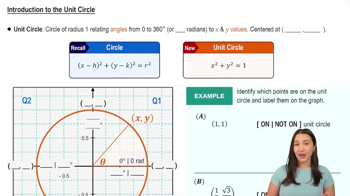
The unit circle is a circle with radius 1 centered at the origin, where angles are measured in radians. Each point on the circle corresponds to an angle t, with coordinates (cos t, sin t). Understanding how angles relate to points on the unit circle is essential for evaluating trigonometric functions like sine and cosine.
Recommended video:
06:11
Introduction to the Unit Circle

Periodic Properties of Trigonometric Functions

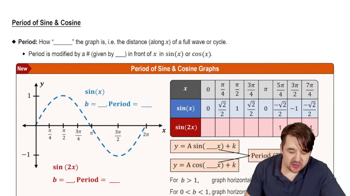
Trigonometric functions such as sine and cosine are periodic, meaning their values repeat at regular intervals. For sine and cosine, the period is 2Ο€, so sin(t) = sin(t + 2Ο€k) for any integer k. This property allows simplification of large angle measures by reducing them modulo 2Ο€.
Recommended video:
5:33
Period of Sine and Cosine Functions

Reference Angles and Angle Reduction

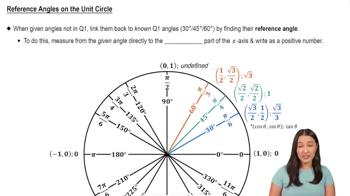
Reference angles help find trigonometric values for angles outside the first rotation by relating them to acute angles within the first quadrant. By subtracting multiples of 2Ο€ or using symmetry, one can find equivalent angles with known sine or cosine values, facilitating the evaluation of functions at large or complex angles.
Recommended video:
5:31
Reference Angles on the Unit Circle