In Exercises 39–54, find the exact value of each expression, if possible. Do not use a calculator. tan⁻¹ (tan 2π/3)
Table of contents
- 0. Review of College Algebra4h 45m
- 1. Measuring Angles40m
- 2. Trigonometric Functions on Right Triangles2h 5m
- 3. Unit Circle1h 19m
- 4. Graphing Trigonometric Functions1h 19m
- 5. Inverse Trigonometric Functions and Basic Trigonometric Equations1h 41m
- 6. Trigonometric Identities and More Equations2h 34m
- 7. Non-Right Triangles1h 38m
- 8. Vectors2h 25m
- 9. Polar Equations2h 5m
- 10. Parametric Equations1h 6m
- 11. Graphing Complex Numbers1h 7m
5. Inverse Trigonometric Functions and Basic Trigonometric Equations
Inverse Sine, Cosine, & Tangent
Problem 53
Textbook Question
In Exercises 52–53, use a right triangle to write each expression as an algebraic expression. Assume that x is positive and that the given inverse trigonometric function is defined for the expression in x. sec(sin⁻¹ 1/x)
Verified step by step guidance1
Recognize that the expression is \( \sec(\sin^{-1}(1/x)) \). Let \( \theta = \sin^{-1}(1/x) \), which means \( \sin(\theta) = \frac{1}{x} \) and \( \theta \) is an angle in a right triangle.
Draw a right triangle where the angle \( \theta \) has an opposite side of length 1 and a hypotenuse of length \( x \), since \( \sin(\theta) = \frac{\text{opposite}}{\text{hypotenuse}} = \frac{1}{x} \).
Use the Pythagorean theorem to find the adjacent side of the triangle: \( \text{adjacent} = \sqrt{x^2 - 1^2} = \sqrt{x^2 - 1} \).
Recall that \( \sec(\theta) = \frac{\text{hypotenuse}}{\text{adjacent}} \). Substitute the known sides to write \( \sec(\sin^{-1}(1/x)) = \frac{x}{\sqrt{x^2 - 1}} \).
Express the final algebraic expression for \( \sec(\sin^{-1}(1/x)) \) as \( \frac{x}{\sqrt{x^2 - 1}} \), which is valid for \( x > 1 \) to keep the expression defined.
Verified video answer for a similar problem:This video solution was recommended by our tutors as helpful for the problem above
Video duration:
5mPlay a video:
0 Comments
Key Concepts
Here are the essential concepts you must grasp in order to answer the question correctly.
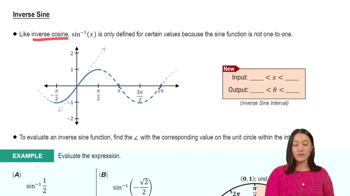
Inverse Sine Function (sin⁻¹ or arcsin)
The inverse sine function, sin⁻¹(y), returns the angle whose sine is y. It is defined for inputs between -1 and 1, and its output angle lies between -π/2 and π/2. Understanding this helps to interpret sin⁻¹(1/x) as an angle in a right triangle where the opposite side over hypotenuse equals 1/x.
Recommended video:
Inverse Sine
Right Triangle Trigonometry
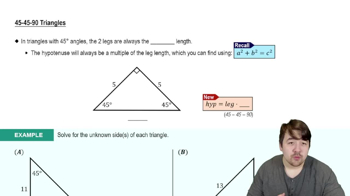
Right triangle trigonometry relates the sides of a right triangle to its angles using sine, cosine, and secant functions. By representing sin⁻¹(1/x) as an angle θ, you can construct a triangle with opposite side 1 and hypotenuse x, then use the Pythagorean theorem to find the adjacent side and express sec(θ) algebraically.
Recommended video:
45-45-90 Triangles
Secant Function (sec)
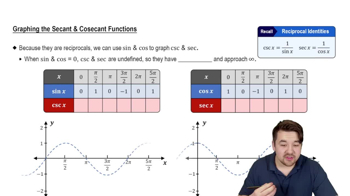
The secant function is the reciprocal of cosine: sec(θ) = 1/cos(θ). After finding the angle θ = sin⁻¹(1/x), sec(θ) can be expressed in terms of the triangle's sides as hypotenuse over adjacent side. This allows rewriting sec(sin⁻¹(1/x)) as an algebraic expression involving x.
Recommended video:
Graphs of Secant and Cosecant Functions
Related Videos
Related Practice
Textbook Question
652
views