Table of contents
- 0. Review of College Algebra4h 45m
- 1. Measuring Angles40m
- 2. Trigonometric Functions on Right Triangles2h 5m
- 3. Unit Circle1h 19m
- 4. Graphing Trigonometric Functions1h 19m
- 5. Inverse Trigonometric Functions and Basic Trigonometric Equations1h 41m
- 6. Trigonometric Identities and More Equations2h 34m
- 7. Non-Right Triangles1h 38m
- 8. Vectors2h 25m
- 9. Polar Equations2h 5m
- 10. Parametric Equations1h 6m
- 11. Graphing Complex Numbers1h 7m
2. Trigonometric Functions on Right Triangles
Solving Right Triangles
Problem 16
Textbook Question
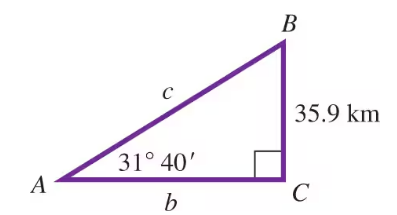
Solve each right triangle. When two sides are given, give angles in degrees and minutes.

Verified step by step guidance1
Identify the two given sides of the right triangle. Label the sides as opposite (O), adjacent (A), or hypotenuse (H) relative to the angle you want to find.
Use the Pythagorean theorem \(H^2 = O^2 + A^2\) to find the missing side if it is not given. This step is essential to have all three sides before finding the angles.
Apply the appropriate trigonometric ratio to find one of the non-right angles. For example, use sine: \(\sin \theta = \frac{O}{H}\), cosine: \(\cos \theta = \frac{A}{H}\), or tangent: \(\tan \theta = \frac{O}{A}\) depending on the sides you know.
Calculate the angle \(\theta\) by taking the inverse trigonometric function (arcsin, arccos, or arctan) of the ratio found in the previous step. This will give the angle in degrees.
Find the other non-right angle by subtracting the first angle from 90 degrees, since the sum of angles in a right triangle is 90 degrees (excluding the right angle). Convert the decimal degrees to degrees and minutes for the final answer.
Verified video answer for a similar problem:This video solution was recommended by our tutors as helpful for the problem above
Play a video:
0 Comments
Key Concepts
Here are the essential concepts you must grasp in order to answer the question correctly.
Pythagorean Theorem
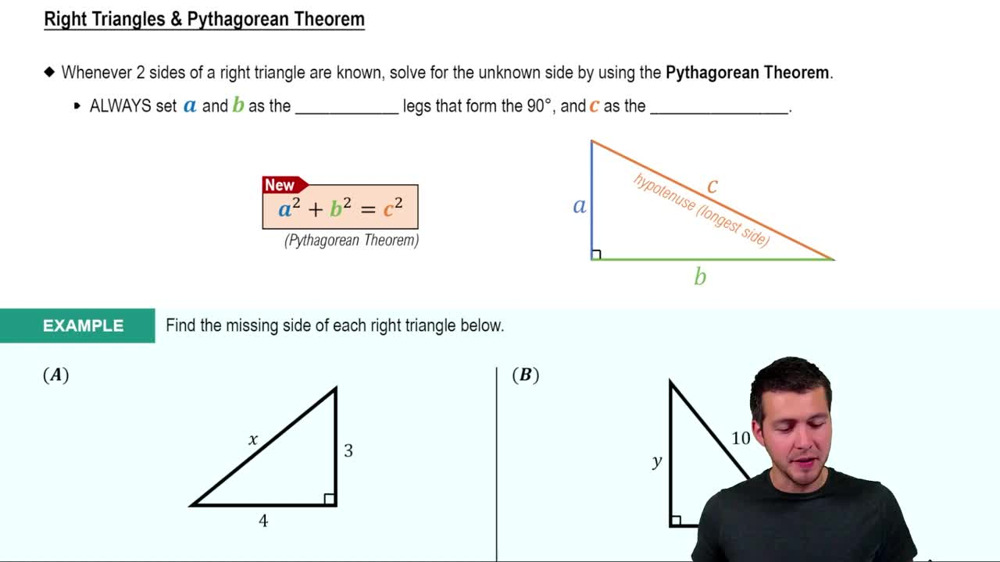
The Pythagorean theorem relates the lengths of the sides in a right triangle: the square of the hypotenuse equals the sum of the squares of the other two sides. It is essential for finding the missing side when two sides are known.
Recommended video:
Solving Right Triangles with the Pythagorean Theorem
Trigonometric Ratios (Sine, Cosine, Tangent)
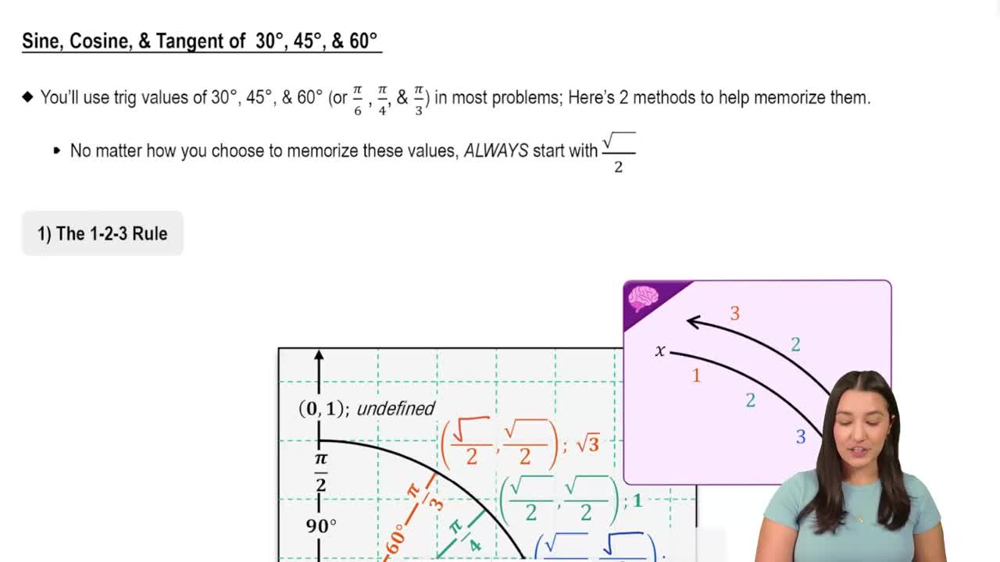
Sine, cosine, and tangent ratios relate the angles of a right triangle to the ratios of its sides. These ratios allow calculation of unknown angles or sides when two sides are given, using inverse trigonometric functions to find angles.
Recommended video:
Sine, Cosine, & Tangent of 30°, 45°, & 60°
Angle Measurement in Degrees and Minutes
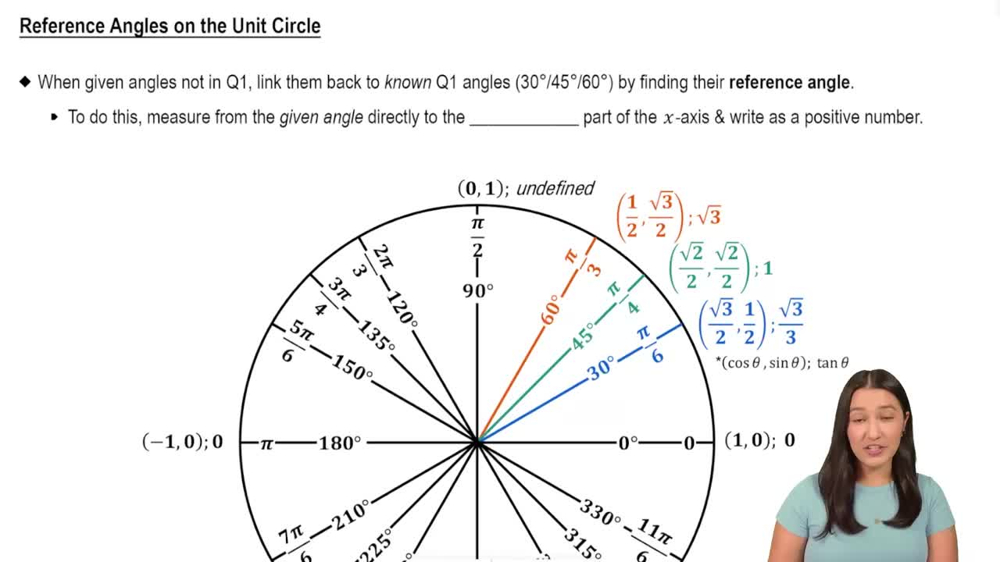
Angles can be expressed in degrees and minutes, where one degree equals 60 minutes. Converting decimal degrees to degrees and minutes is important for precise angle representation, especially in practical applications like navigation or engineering.
Recommended video:
Reference Angles on the Unit Circle
Related Videos
Related Practice
Textbook Question
CONCEPT PREVIEW Match each equation in Column I with the appropriate right triangle in Column II. In each case, the goal is to find the value of x. I II1. A. B. C. 2. 3. D. E. F. 4.5. x = 5 sin 38°6.
446
views
