Identify the expression to simplify: \(\frac{\frac{\sqrt{3}}{2}}{1 - \frac{\sqrt{3}}{2}}\).
Rewrite the complex fraction as a division of two fractions: \(\frac{\sqrt{3}}{2} \div \left(1 - \frac{\sqrt{3}}{2}\right)\).
Simplify the denominator by expressing 1 as \(\frac{2}{2}\) to have a common denominator: \(1 - \frac{\sqrt{3}}{2} = \frac{2}{2} - \frac{\sqrt{3}}{2} = \frac{2 - \sqrt{3}}{2}\).
Rewrite the division as multiplication by the reciprocal: \(\frac{\sqrt{3}}{2} \times \frac{2}{2 - \sqrt{3}}\).
Cancel common factors if possible and then rationalize the denominator by multiplying numerator and denominator by the conjugate of the denominator, which is \(2 + \sqrt{3}\).
Verified video answer for a similar problem:
This video solution was recommended by our tutors as helpful for the problem above
Video duration:
5m
Play a video:
0 Comments
Key Concepts
Here are the essential concepts you must grasp in order to answer the question correctly.
Rationalizing the Denominator
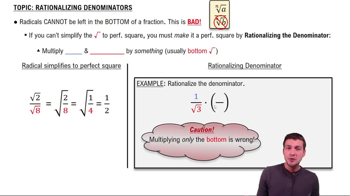
Rationalizing the denominator involves eliminating any irrational numbers, such as square roots, from the denominator of a fraction. This is typically done by multiplying the numerator and denominator by a conjugate or an appropriate radical to simplify the expression.
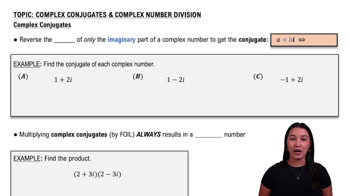
The conjugate of a binomial expression a + b is a - b, and vice versa. Multiplying by the conjugate helps remove square roots from denominators because it uses the difference of squares formula, resulting in a rational number.
Simplifying square roots involves expressing them in simplest radical form, while simplifying fractions means reducing them to their lowest terms. Combining these skills helps in rewriting expressions in a clearer, more manageable form.

 5:59 minutes
 Verified step by step guidance
 2:58
2:58