
Textbook Question
Match each trigonometric function in Column I with its value in Column II. Choices may be used once, more than once, or not at all.
cot 30°
446
views

 Verified step by step guidance
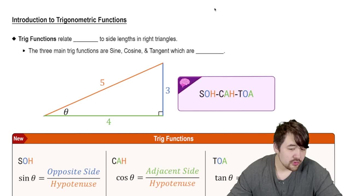
 6:04
6:04
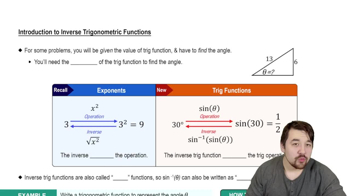 4:28
4:28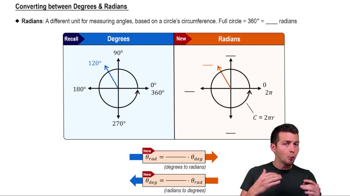 5:04
5:04Match each trigonometric function in Column I with its value in Column II. Choices may be used once, more than once, or not at all.
cot 30°
CONCEPT PREVIEW Match each trigonometric function in Column I with its value in Column II. Choices may be used once, more than once, or not at all.
csc 60°
Concept Check Match each angle in Column I with its reference angle in Column II. Choices may be used once, more than once, or not at all. See Example 1. I. II. 5. A. 45° 6. 212° B. 60° 7. C. 82° 8. D. 30° 9. E. 38° 10. F. 32°
CONCEPT PREVIEW Match each trigonometric function value or angle in Column I with its appropriate approximation in Column II.
Column I: 1.
sin⁻¹ 0.30
Column II:
A. 88.09084757°
B. 63.25631605°
C. 1.909152433°
D. 17.45760312°
E. 0.2867453858
F. 1.962610506
G. 14.47751219°
H. 1.015426612
I. 1.051462224
J. 0.9925461516
Find one solution for each equation. Assume all angles involved are acute angles. cos(3θ + 11°) = sin( 7θ + 40°) 5 10
CONCEPT PREVIEW Match each trigonometric function value or angle in Column I with its appropriate approximation in Column II.
Column I: 1.
cot 27°
Column II:
A. 88.09084757°
B. 63.25631605°
C. 1.909152433°
D. 17.45760312°
E. 0.2867453858
F. 1.962610506
G. 14.47751219°
H. 1.015426612
I. 1.051462224
J. 0.9925461516