Ch. 5 - Complex Numbers, Polar Coordinates and Parametric Equations
Blitzer - Trigonometry 3rd Edition
Blitzer3rd EditionTrigonometryISBN: 9780137316601Not the one you use?Change textbook
Chapter 5, Problem 79

In Exercises 79–80, convert each polar equation to a rectangular equation. Then determine the graph's slope and y-intercept.
r sin (θ − π/4) = 2

Verified step by step guidance
1
Recall the relationships between polar and rectangular coordinates: \(x = r \cos \theta\) and \(y = r \sin \theta\). Also, \(r = \sqrt{x^2 + y^2}\) and \(\tan \theta = \frac{y}{x}\).
Use the angle difference identity for sine: \(\sin(\theta - \frac{\pi}{4}) = \sin \theta \cos \frac{\pi}{4} - \cos \theta \sin \frac{\pi}{4}\). Substitute this into the given equation to get \(r (\sin \theta \cos \frac{\pi}{4} - \cos \theta \sin \frac{\pi}{4}) = 2\).
Since \(\cos \frac{\pi}{4} = \sin \frac{\pi}{4} = \frac{\sqrt{2}}{2}\), rewrite the equation as \(r \left( \sin \theta \frac{\sqrt{2}}{2} - \cos \theta \frac{\sqrt{2}}{2} \right) = 2\).
Distribute \(r\) and replace \(r \sin \theta\) with \(y\) and \(r \cos \theta\) with \(x\), yielding \(\frac{\sqrt{2}}{2} y - \frac{\sqrt{2}}{2} x = 2\).
Multiply both sides by \(\sqrt{2}\) to clear the fractions, then rearrange the equation into the slope-intercept form \(y = mx + b\) to identify the slope and y-intercept.

Verified video answer for a similar problem:

This video solution was recommended by our tutors as helpful for the problem above.
Video duration:
6m
Was this helpful?

Key Concepts

Here are the essential concepts you must grasp in order to answer the question correctly.

Conversion between Polar and Rectangular Coordinates

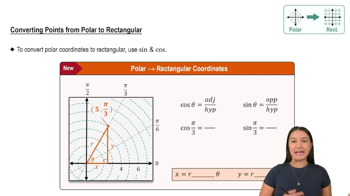
Polar coordinates (r, θ) relate to rectangular coordinates (x, y) through the formulas x = r cos θ and y = r sin θ. Converting a polar equation to rectangular form involves substituting these expressions to rewrite the equation in terms of x and y.
Recommended video:
06:17
Convert Points from Polar to Rectangular

Trigonometric Angle Difference Identity

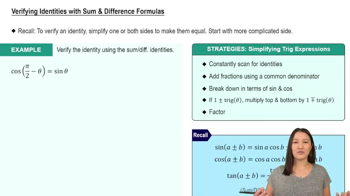
The angle difference identity for sine states that sin(α − β) = sin α cos β − cos α sin β. Applying this identity to sin(θ − π/4) allows the polar equation to be expanded into terms involving sin θ and cos θ, facilitating conversion to rectangular coordinates.
Recommended video:
2:25
Verifying Identities with Sum and Difference Formulas

Slope and Y-Intercept of a Line

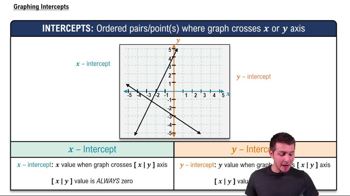
Once the equation is in rectangular form (y = mx + b), the slope (m) represents the line's steepness, and the y-intercept (b) is the point where the line crosses the y-axis. Identifying these helps in graphing and understanding the line's behavior.
Recommended video:
4:08
Graphing Intercepts