Verify that each equation is an identity. sec⁴ x - sec² x = tan⁴ x + tan² x
Verified step by step guidance
1
Start by recalling the Pythagorean identity: \( \sec^2 x = 1 + \tan^2 x \).
Substitute \( \sec^2 x = 1 + \tan^2 x \) into the left side of the equation: \( \sec^4 x - \sec^2 x \).
Rewrite \( \sec^4 x \) as \( (\sec^2 x)^2 \) and substitute \( \sec^2 x = 1 + \tan^2 x \) to get \( ((1 + \tan^2 x)^2) - (1 + \tan^2 x) \).
Expand \( (1 + \tan^2 x)^2 \) to \( 1 + 2\tan^2 x + \tan^4 x \) and simplify the expression: \( 1 + 2\tan^2 x + \tan^4 x - 1 - \tan^2 x \).
Combine like terms to verify the identity: \( \tan^4 x + \tan^2 x \).
Verified video answer for a similar problem:
This video solution was recommended by our tutors as helpful for the problem above
Play a video:
0 Comments
Key Concepts
Here are the essential concepts you must grasp in order to answer the question correctly.
Trigonometric Identities
Trigonometric identities are equations that hold true for all values of the variable where both sides are defined. Common identities include the Pythagorean identities, reciprocal identities, and quotient identities. Understanding these identities is crucial for verifying equations and simplifying expressions in trigonometry.
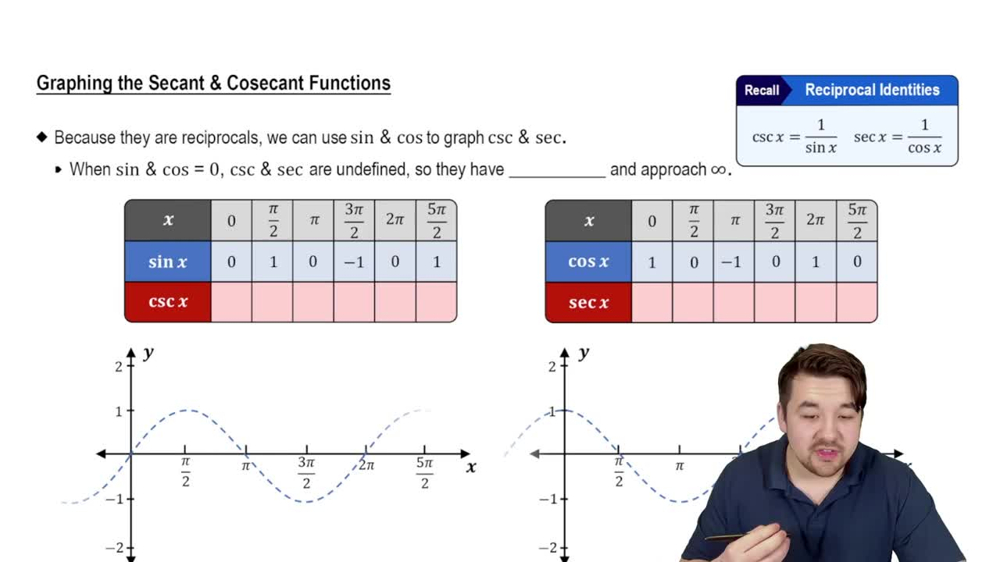
The secant function, sec(x), is defined as the reciprocal of the cosine function, while the tangent function, tan(x), is the ratio of the sine function to the cosine function. These functions are fundamental in trigonometry and are often used in identities and equations. Recognizing their relationships helps in manipulating and verifying trigonometric equations.
Algebraic manipulation involves rearranging and simplifying equations using algebraic rules. This includes factoring, expanding, and combining like terms. In the context of verifying trigonometric identities, effective algebraic manipulation allows one to transform one side of the equation to match the other, confirming the identity.

 Verified step by step guidance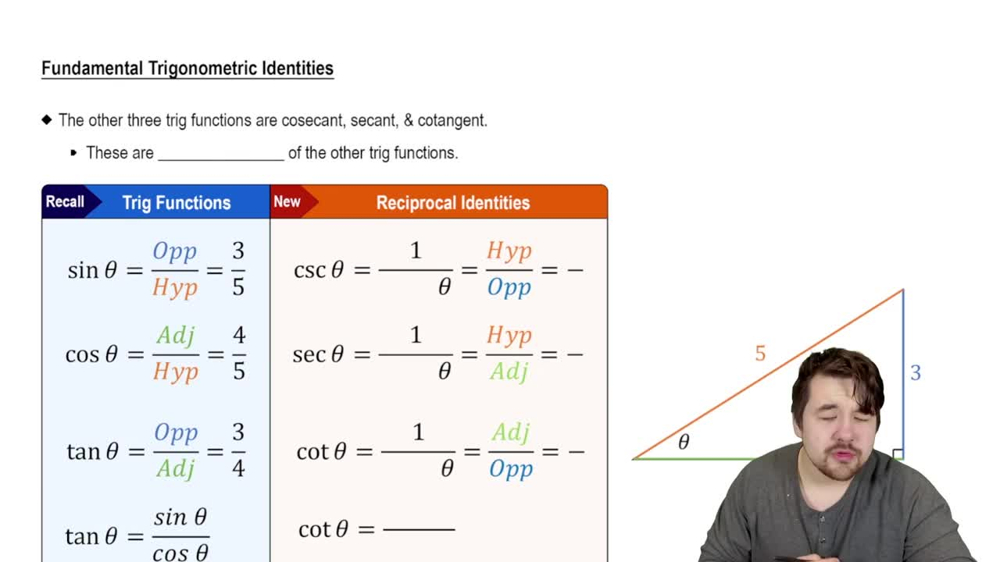
 5:32
5:32