Ch. 5 - Complex Numbers, Polar Coordinates and Parametric Equations
Blitzer - Trigonometry 3rd Edition
Blitzer3rd EditionTrigonometryISBN: 9780137316601Not the one you use?Change textbook
Chapter 5, Problem 32

In Exercises 32–35, find all the complex roots. Write roots in rectangular form. The complex fourth roots of 16 (cos 2π/3 + i sin 2π/3)

Verified step by step guidance
1
Identify the given complex number in polar (trigonometric) form: \(16 \left( \cos \frac{2\pi}{3} + i \sin \frac{2\pi}{3} \right)\). Here, the modulus \(r = 16\) and the argument \(\theta = \frac{2\pi}{3}\).
Recall that the \(n\)th roots of a complex number \(r (\cos \theta + i \sin \theta)\) are given by the formula: \(\sqrt[n]{r} \left( \cos \frac{\theta + 2k\pi}{n} + i \sin \frac{\theta + 2k\pi}{n} \right)\), where \(k = 0, 1, 2, ..., n-1\).
Since we want the fourth roots (\(n=4\)), calculate the modulus of each root as \(\sqrt[4]{16}\) and the arguments as \(\frac{\frac{2\pi}{3} + 2k\pi}{4}\) for \(k = 0, 1, 2, 3\).
Write each root in trigonometric form using the calculated modulus and arguments for each \(k\). That is, for each \(k\), the root is: \(\sqrt[4]{16} \left( \cos \left( \frac{2\pi/3 + 2k\pi}{4} \right) + i \sin \left( \frac{2\pi/3 + 2k\pi}{4} \right) \right)\).
Convert each root from trigonometric form to rectangular form using the identities: \(x = r \cos \theta\) and \(y = r \sin \theta\), so each root is \(x + iy\).

Verified video answer for a similar problem:

This video solution was recommended by our tutors as helpful for the problem above.
Was this helpful?

Key Concepts

Here are the essential concepts you must grasp in order to answer the question correctly.

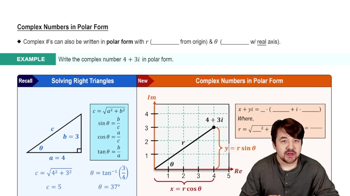
Complex Numbers in Polar Form

Complex numbers can be expressed in polar form as r(cos θ + i sin θ), where r is the magnitude and θ is the argument (angle). This form simplifies multiplication, division, and finding roots by working with magnitudes and angles separately.
Recommended video:
04:47
Complex Numbers In Polar Form

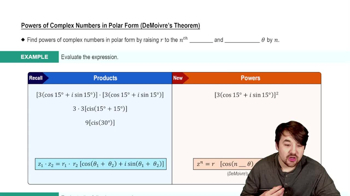
De Moivre's Theorem

De Moivre's theorem states that for a complex number in polar form, raising it to the nth power or extracting nth roots involves raising the magnitude to the nth power or root and multiplying or dividing the angle by n. This theorem is essential for finding complex roots.
Recommended video:
03:41
Powers Of Complex Numbers In Polar Form (DeMoivre's Theorem)

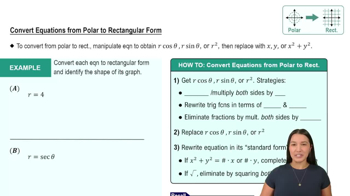
Conversion Between Polar and Rectangular Forms

After finding roots in polar form, converting them to rectangular form (a + bi) requires using a = r cos θ and b = r sin θ. This step is necessary to express the roots in the standard complex number format.
Recommended video:
6:50
Convert Equations from Polar to Rectangular