Table of contents
- 0. Review of College Algebra4h 45m
- 1. Measuring Angles40m
- 2. Trigonometric Functions on Right Triangles2h 5m
- 3. Unit Circle1h 19m
- 4. Graphing Trigonometric Functions1h 19m
- 5. Inverse Trigonometric Functions and Basic Trigonometric Equations1h 41m
- 6. Trigonometric Identities and More Equations2h 34m
- 7. Non-Right Triangles1h 38m
- 8. Vectors2h 25m
- 9. Polar Equations2h 5m
- 10. Parametric Equations1h 6m
- 11. Graphing Complex Numbers1h 7m
1. Measuring Angles
Angles in Standard Position
Problem 126
Textbook Question
Solve each problem. See Example 6. Rotating Airplane Propeller An airplane propeller rotates 1000 times per min. Find the number of degrees that a point on the edge of the propeller will rotate in 2 sec.
Verified step by step guidance1
Identify the given information: the propeller rotates 1000 times per minute, and we want to find the degrees rotated in 2 seconds.
Convert the rotation rate from revolutions per minute to revolutions per second by dividing 1000 by 60, since there are 60 seconds in a minute. This gives revolutions per second.
Calculate the total number of revolutions in 2 seconds by multiplying the revolutions per second by 2.
Recall that one full revolution corresponds to 360 degrees. Use this to convert the total revolutions into degrees by multiplying the number of revolutions by 360.
Write the final expression for the degrees rotated in 2 seconds as: \(\text{Degrees} = \left(\frac{1000}{60} \times 2\right) \times 360\).
Verified video answer for a similar problem:This video solution was recommended by our tutors as helpful for the problem above
Video duration:
2mPlay a video:
0 Comments
Key Concepts
Here are the essential concepts you must grasp in order to answer the question correctly.
Angular Velocity
Angular velocity measures how fast an object rotates, typically expressed in revolutions per minute (rpm) or radians per second. It indicates the angle covered per unit time, which is essential for converting rotational speed into degrees or radians over a given time interval.
Recommended video:
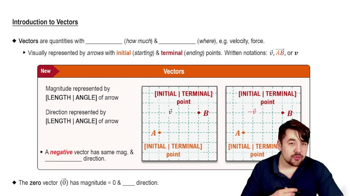
Introduction to Vectors
Unit Conversion Between Time and Angle
To solve rotation problems, it's crucial to convert time units (minutes to seconds) and angular units (revolutions to degrees). Since one revolution equals 360 degrees, multiplying the number of revolutions by 360 gives the total degrees rotated.
Recommended video:
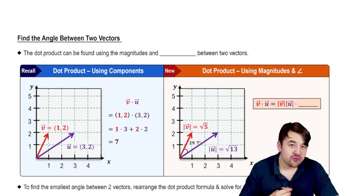
Find the Angle Between Vectors
Proportional Reasoning in Rotation
Proportional reasoning helps relate the rotation in a given time to the total rotation rate. By setting up ratios between time intervals and revolutions, one can find the degrees rotated in any specified duration, such as 2 seconds in this problem.
Recommended video:
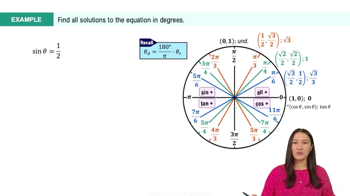
Example 2
Related Videos
Related Practice
Textbook Question
Find a value of θ, in the interval [0°, 90°) that satisfies each statement. Give answers in decimal degrees to six decimal places.csc θ = 9.5670466
502
views