
Textbook Question
Match each trigonometric function in Column I with its value in Column II. Choices may be used once, more than once, or not at all.
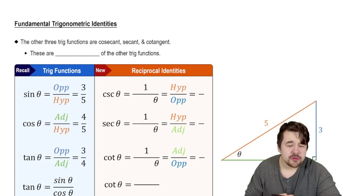
cot 30°
446
views

 Verified step by step guidance
 5:32
5:32
 6:36
6:36 05:50
05:50Match each trigonometric function in Column I with its value in Column II. Choices may be used once, more than once, or not at all.
cot 30°
Concept Check Match each angle in Column I with its reference angle in Column II. Choices may be used once, more than once, or not at all. See Example 1. I. II. 5. A. 45° 6. B. 60° 7. -135° C. 82° 8. D. 30° 9. E. 38° 10. F. 32°
Concept Check Match each angle in Column I with its reference angle in Column II. Choices may be used once, more than once, or not at all. See Example 1. I. II. 5. A. 45° 6. 212° B. 60° 7. C. 82° 8. D. 30° 9. E. 38° 10. F. 32°
CONCEPT PREVIEW Match each trigonometric function value or angle in Column I with its appropriate approximation in Column II.
Column I: 1.
sec 18°
Column II:
A. 88.09084757°
B. 63.25631605°
C. 1.909152433°
D. 17.45760312°
E. 0.2867453858
F. 1.962610506
G. 14.47751219°
H. 1.015426612
I. 1.051462224
J. 0.9925461516
Find exact values or expressions for sin A, cos A, and tan A. See Example 1.
CONCEPT PREVIEW Match each trigonometric function value or angle in Column I with its appropriate approximation in Column II.
Column I: 1.
scs 80°
Column II:
A. 88.09084757°
B. 63.25631605°
C. 1.909152433°
D. 17.45760312°
E. 0.2867453858
F. 1.962610506
G. 14.47751219°
H. 1.015426612
I. 1.051462224
J. 0.9925461516