Use the figure to find each vector: - u. Use vector notation as in Example 4.
Ch. 7 - Applications of Trigonometry and Vectors
Chapter 8, Problem 33
Solve each triangle. See Examples 2 and 3.
A = 112.8°, b = 6.28 m, c = 12.2 m
Verified step by step guidance1
Identify the given elements of the triangle: angle \(A = 112.8^\circ\), side \(b = 6.28\) m, and side \(c = 12.2\) m. We need to find the remaining angles \(B\) and \(C\), and side \(a\).
Use the Law of Cosines to find side \(a\). The Law of Cosines formula is:
\[a^2 = b^2 + c^2 - 2bc \cos A\]
Substitute the known values of \(b\), \(c\), and \(A\) into this formula.
Calculate \(a\) by taking the square root of the result from the Law of Cosines step:
\[a = \sqrt{b^2 + c^2 - 2bc \cos A}\]
Use the Law of Sines to find one of the unknown angles, for example angle \(B\). The Law of Sines states:
\[\frac{\sin A}{a} = \frac{\sin B}{b}\]
Rearrange to solve for \(\sin B\):
\[\sin B = b \times \frac{\sin A}{a}\]
Calculate angle \(B\) by taking the inverse sine (arcsin) of \(\sin B\). Then find angle \(C\) using the fact that the sum of angles in a triangle is \(180^\circ\):
\[C = 180^\circ - A - B\]

Verified video answer for a similar problem:
This video solution was recommended by our tutors as helpful for the problem above.
Was this helpful?
Key Concepts
Here are the essential concepts you must grasp in order to answer the question correctly.
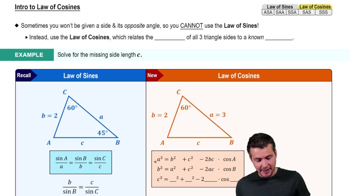
Law of Cosines
The Law of Cosines relates the lengths of the sides of a triangle to the cosine of one of its angles. It is especially useful for solving triangles when two sides and the included angle are known. The formula is c² = a² + b² - 2ab cos(C), allowing calculation of unknown sides or angles.
Recommended video:
Intro to Law of Cosines
Triangle Angle Sum Property
The sum of the interior angles in any triangle is always 180°. Knowing one angle and two sides allows you to find the remaining angles by subtracting the known angles from 180°, which is essential for fully solving the triangle.
Recommended video:
Sum and Difference of Tangent
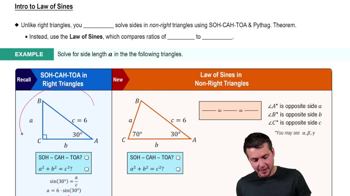
Law of Sines
The Law of Sines states that the ratio of the length of a side to the sine of its opposite angle is constant in a triangle: a/sin(A) = b/sin(B) = c/sin(C). This law helps find unknown angles or sides when given an angle-side pair and another side or angle.
Recommended video:
Intro to Law of Sines
Related Practice
Textbook Question
677
views
Textbook Question
Given u = 〈-2, 5〉 and v = 〈4, 3〉, find each of the following.
v - u
723
views
Textbook Question
To determine the distance RS across a deep canyon, Rhonda lays off a distance TR = 582 yd. She then finds that T = 32° 50' and R = 102° 20'. Find RS. See the figure.
<IMAGE>
727
views
Textbook Question
Two forces of 692 newtons and 423 newtons act on a point. The resultant force is 786 newtons. Find the angle between the forces.
842
views
Textbook Question
Two rescue vessels are pulling a broken-down motorboat toward a boathouse with forces of 840 lb and 960 lb. The angle between these forces is 24.5°. Find the direction and magnitude of the equilibrant.
801
views
Textbook Question
Without using the law of sines, explain why no triangle ABC can exist that satisfies A = 103° 20', a = 14.6 ft, b = 20.4 ft.
884
views