Identify the given elements of the triangle: angle \(A = 112.8^\circ\), side \(b = 6.28\) m, and side \(c = 12.2\) m. We need to find the remaining angles \(B\) and \(C\), and side \(a\).
Use the Law of Cosines to find side \(a\). The Law of Cosines formula is:
\[a^2 = b^2 + c^2 - 2bc \cos A\]
Substitute the known values of \(b\), \(c\), and \(A\) into this formula.
Calculate \(a\) by taking the square root of the result from the Law of Cosines step:
\[a = \sqrt{b^2 + c^2 - 2bc \cos A}\]
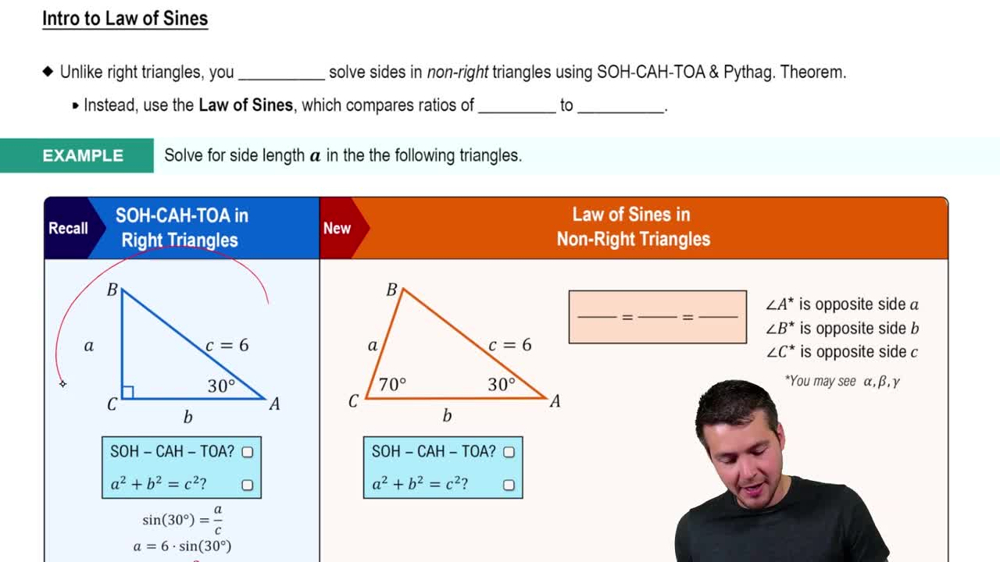
Use the Law of Sines to find one of the unknown angles, for example angle \(B\). The Law of Sines states:
\[\frac{\sin A}{a} = \frac{\sin B}{b}\]
Rearrange to solve for \(\sin B\):
\[\sin B = b \times \frac{\sin A}{a}\]
Calculate angle \(B\) by taking the inverse sine (arcsin) of \(\sin B\). Then find angle \(C\) using the fact that the sum of angles in a triangle is \(180^\circ\):
\[C = 180^\circ - A - B\]
Verified video answer for a similar problem:
This video solution was recommended by our tutors as helpful for the problem above
Play a video:
0 Comments
Key Concepts
Here are the essential concepts you must grasp in order to answer the question correctly.
Law of Cosines
The Law of Cosines relates the lengths of the sides of a triangle to the cosine of one of its angles. It is especially useful for solving triangles when two sides and the included angle are known. The formula is c² = a² + b² - 2ab cos(C), allowing calculation of unknown sides or angles.
The sum of the interior angles in any triangle is always 180°. Knowing one angle and two sides allows you to find the remaining angles by subtracting the known angles from 180°, which is essential for fully solving the triangle.
The Law of Sines states that the ratio of the length of a side to the sine of its opposite angle is constant in a triangle: a/sin(A) = b/sin(B) = c/sin(C). This law helps find unknown angles or sides when given an angle-side pair and another side or angle.

 Verified step by step guidance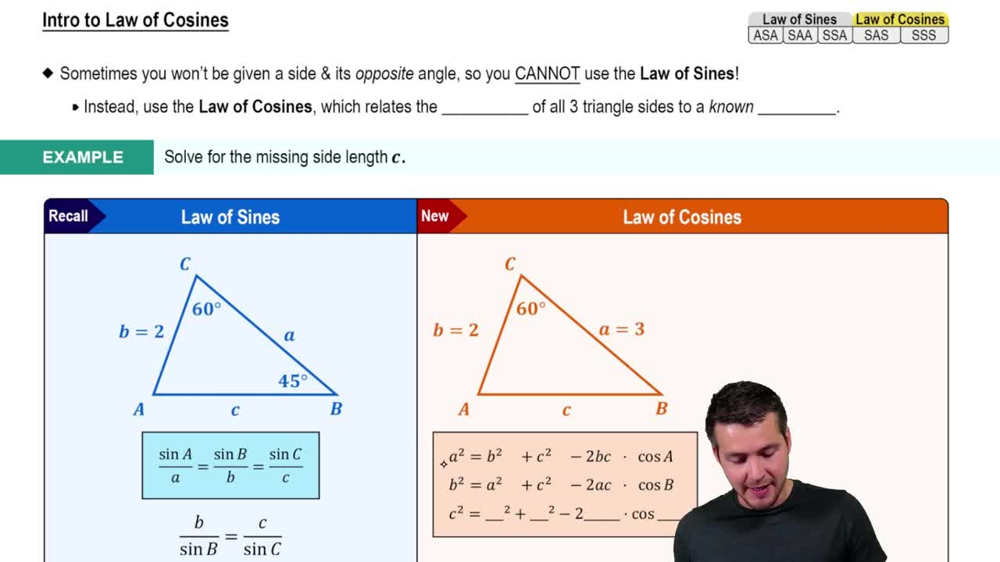
 4:35
4:35