Ch. 1 - Trigonometric Functions
Lial - Trigonometry 12th Edition
Lial12th EditionTrigonometryISBN: 9780136552161Not the one you use?Change textbook
Chapter 2, Problem 96

Use trigonometric function values of quadrantal angles to evaluate each expression. ―3(sin 90°)⁴ + 4(cos 180°)³

Verified step by step guidance
1
Recall the values of sine and cosine at quadrantal angles: \( \sin 90^\circ = 1 \) and \( \cos 180^\circ = -1 \).
Evaluate \( (\sin 90^\circ)^4 \) by raising \( \sin 90^\circ = 1 \) to the 4th power: \( 1^4 \).
Evaluate \( (\cos 180^\circ)^3 \) by raising \( \cos 180^\circ = -1 \) to the 3rd power: \( (-1)^3 \).
Substitute these values back into the expression: \( -3 \times (1^4) + 4 \times (-1)^3 \).
Simplify the expression step-by-step by performing the multiplications and additions to find the final value.

Verified video answer for a similar problem:

This video solution was recommended by our tutors as helpful for the problem above.
Video duration:
2m
Was this helpful?

Key Concepts

Here are the essential concepts you must grasp in order to answer the question correctly.

Quadrantal Angles

Quadrantal angles are angles located on the x- or y-axis in the coordinate plane, specifically 0°, 90°, 180°, 270°, and 360°. Their sine and cosine values are always 0, ±1, which simplifies trigonometric calculations significantly.
Recommended video:
6:36
Quadratic Formula

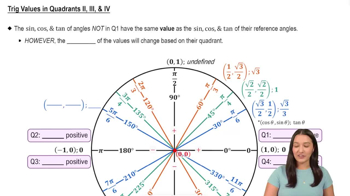
Trigonometric Function Values at Quadrantal Angles

The sine and cosine values at quadrantal angles are fixed: sin 90° = 1, cos 180° = -1, etc. Knowing these exact values allows direct substitution into expressions without approximation, making evaluation straightforward.
Recommended video:
5:30
Trig Values in Quadrants II, III, & IV

Exponentiation of Trigonometric Values

Raising sine or cosine values to powers involves multiplying the value by itself repeatedly. For example, (sin 90°)⁴ means (1)⁴ = 1. Understanding how powers affect ±1 and 0 is crucial for correctly simplifying expressions.
Recommended video:
5:32
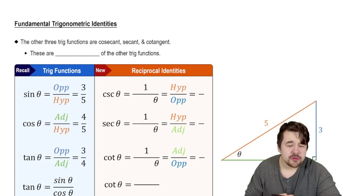
Fundamental Trigonometric Identities