Find each exact function value. See Example 3. cos 3π
Verified step by step guidance
1
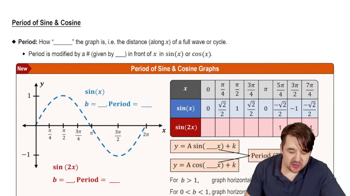
Recall the periodicity property of the cosine function: cosine has a period of \(2\pi\), which means \(\cos(\theta) = \cos(\theta + 2k\pi)\) for any integer \(k\).
Use the periodicity to simplify \(\cos 3\pi\) by subtracting \(2\pi\) to find an equivalent angle within the standard interval \([0, 2\pi)\): \(3\pi - 2\pi = \pi\).
Rewrite the expression using this equivalent angle: \(\cos 3\pi = \cos \pi\).
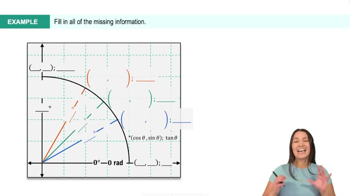
Recall the exact value of \(\cos \pi\), which corresponds to the cosine of 180 degrees on the unit circle.
Conclude that \(\cos 3\pi\) is equal to the exact value of \(\cos \pi\), which you can identify from the unit circle.
Verified video answer for a similar problem:
This video solution was recommended by our tutors as helpful for the problem above
Play a video:
0 Comments
Key Concepts
Here are the essential concepts you must grasp in order to answer the question correctly.
Unit Circle and Radian Measure
The unit circle is a circle with radius 1 centered at the origin, used to define trigonometric functions for all angles. Radian measure relates the angle to the length of the arc on the unit circle, where 2π radians equal 360 degrees. Understanding radians helps in locating angles like 3π on the circle.
The cosine function measures the x-coordinate of a point on the unit circle corresponding to a given angle. It is periodic with period 2π, meaning cos(θ) = cos(θ + 2πk) for any integer k. This property allows simplification of angles like 3π by reducing them modulo 2π.
Certain angles on the unit circle have known exact cosine values, such as 0, π/2, π, 3π/2, and 2π. Recognizing these special angles helps in finding exact trigonometric values without a calculator. For example, cos(π) = -1, which aids in evaluating cos(3π) by using periodicity.

 Verified step by step guidance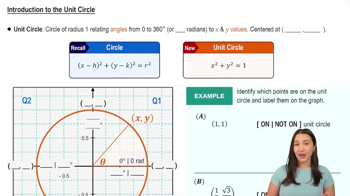
 06:11
06:11