Convert each angle measure to decimal degrees. If applicable, round to the nearest thousandth of a degree. 112° 15'
Ch. 1 - Trigonometric Functions
Chapter 2, Problem 57
Find the unknown side lengths in each pair of similar triangles. See Example 4.
Verified step by step guidance1
Identify the pairs of corresponding sides in the similar triangles. Since the triangles are similar, their corresponding angles are equal, and their corresponding sides are proportional.
Set up a proportion between the lengths of the corresponding sides. For example, if the sides of the first triangle are \(a\), \(b\), and \(c\), and the corresponding sides of the second triangle are \(x\), \(y\), and \(z\), then the ratios \(\frac{a}{x} = \frac{b}{y} = \frac{c}{z}\) hold true.
Use the known side lengths to write an equation involving the unknown side length. For instance, if you know \(a\), \(b\), and \(x\), and want to find \(y\), use the proportion \(\frac{a}{x} = \frac{b}{y}\).
Solve the equation for the unknown side length by cross-multiplying and isolating the variable. This will give you an expression for the unknown side in terms of the known sides.
Repeat the process for any other unknown sides, ensuring that you always match corresponding sides and maintain the correct ratio from the similarity of the triangles.

Verified video answer for a similar problem:
This video solution was recommended by our tutors as helpful for the problem above.
Video duration:
3mWas this helpful?
Key Concepts
Here are the essential concepts you must grasp in order to answer the question correctly.
Similarity of Triangles
Two triangles are similar if their corresponding angles are equal and their corresponding sides are in proportion. This means the shape is the same but the size may differ, allowing us to set up ratios between corresponding sides to find unknown lengths.
Recommended video:
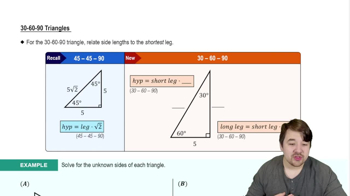
30-60-90 Triangles
Corresponding Sides and Angles
In similar triangles, each side corresponds to a side in the other triangle opposite the same angle. Identifying these pairs correctly is essential to apply proportional reasoning and solve for unknown side lengths accurately.
Recommended video:
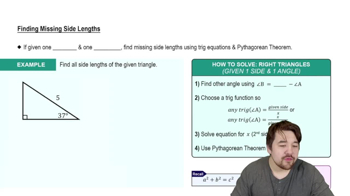
Finding Missing Side Lengths
Setting Up and Solving Proportions
Once corresponding sides are identified, their lengths form ratios that are equal. Solving these proportions involves cross-multiplication and algebraic manipulation to find the unknown side lengths in one of the triangles.
Recommended video:
Solving Linear Equations
Related Practice
Textbook Question
687
views
Textbook Question
Determine whether each statement is possible or impossible. See Example 4. tan θ = 0.93
842
views
Textbook Question
Convert each angle measure to decimal degrees. If applicable, round to the nearest thousandth of a degree. - 70° 48'
640
views
Textbook Question
Convert each angle measure to decimal degrees. If applicable, round to the nearest thousandth of a degree. See Example 4(a). 38° 42' 18"
646
views
Textbook Question
An equation of the terminal side of an angle θ in standard position is given with a restriction on x. Sketch the least positive such angle θ , and find the values of the six trigonometric functions of θ . See Example 3. ―5x ― 3y = 0 , x ≤ 0
504
views
Textbook Question
Convert each angle measure to decimal degrees. If applicable, round to the nearest thousandth of a degree. See Example 4(a). 82° 30'
981
views