In Exercises 17–30, determine the amplitude, period, and phase shift of each function. Then graph one period of the function. y = −2 sin(2x + π/2)
Table of contents
- 0. Review of College Algebra4h 45m
- 1. Measuring Angles40m
- 2. Trigonometric Functions on Right Triangles2h 5m
- 3. Unit Circle1h 19m
- 4. Graphing Trigonometric Functions1h 19m
- 5. Inverse Trigonometric Functions and Basic Trigonometric Equations1h 41m
- 6. Trigonometric Identities and More Equations2h 34m
- 7. Non-Right Triangles1h 38m
- 8. Vectors2h 25m
- 9. Polar Equations2h 5m
- 10. Parametric Equations1h 6m
- 11. Graphing Complex Numbers1h 7m
4. Graphing Trigonometric Functions
Graphs of the Sine and Cosine Functions
Problem 62
Textbook Question
In Exercises 61–66, use the method of adding y-coordinates to graph each function for 0 ≤ x ≤ 2π. y = 3 cos x + sin x
Verified step by step guidance1
Identify the given function: \(y = 3 \cos x + \sin x\). We want to graph this function for \(0 \leq x \leq 2\pi\) by adding the \(y\)-coordinates of the individual trigonometric functions \(3 \cos x\) and \(\sin x\).
Create a table of values for \(x\) at key points within the interval \([0, 2\pi]\), such as \$0\(, \(\frac{\pi}{2}\), \(\pi\), \(\frac{3\pi}{2}\), and \(2\pi\). For each \)x$, calculate \(3 \cos x\) and \(\sin x\) separately.
For each \(x\) value, add the corresponding \(y\)-coordinates: \(y = 3 \cos x + \sin x\). This means summing the values found for \(3 \cos x\) and \(\sin x\) at each \(x\).
Plot the points \((x, y)\) on the coordinate plane using the summed \(y\)-values from the previous step. This will give you points on the graph of the function \(y = 3 \cos x + \sin x\).
Connect the plotted points smoothly, keeping in mind the periodic and wave-like nature of sine and cosine functions, to complete the graph over the interval \(0 \leq x \leq 2\pi\).
Verified video answer for a similar problem:This video solution was recommended by our tutors as helpful for the problem above
Video duration:
8mPlay a video:
0 Comments
Key Concepts
Here are the essential concepts you must grasp in order to answer the question correctly.
Graphing Trigonometric Functions
Graphing trigonometric functions involves plotting points based on their values at various x-coordinates, typically within one period such as 0 to 2π. Understanding the shape and behavior of sine and cosine functions helps in visualizing their graphs and how they combine.
Recommended video:
Introduction to Trigonometric Functions
Superposition of Functions (Adding y-coordinates)
When combining functions like y = 3 cos x + sin x, the graph is formed by adding the y-values of each function at corresponding x-values. This method, called superposition, helps in constructing the resultant graph by pointwise addition of the individual function values.
Recommended video:
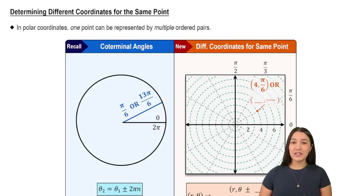
Determining Different Coordinates for the Same Point
Amplitude and Phase Shift in Combined Trigonometric Functions
The combination y = 3 cos x + sin x can be rewritten as a single sinusoidal function with a specific amplitude and phase shift. Understanding how to find this equivalent form helps in analyzing the maximum and minimum values and the horizontal shift of the graph.
Recommended video:
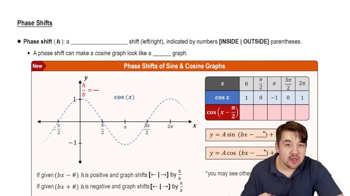
Phase Shifts
Related Videos
Related Practice
Textbook Question
1260
views