Ch. 6 - Inverse Circular Functions and Trigonometric Equations
Lial - Trigonometry 12th Edition
Lial12th EditionTrigonometryISBN: 9780136552161Not the one you use?Change textbook
Chapter 7, Problem 25

Solve each equation for exact solutions.
-4 arcsin x = π

Verified step by step guidance
1
Start with the given equation: \(-4 \arcsin x = \pi\).
Isolate \(\arcsin x\) by dividing both sides of the equation by \(-4\): \(\arcsin x = \frac{\pi}{-4} = -\frac{\pi}{4}\).
Recall that \(\arcsin x\) is the inverse sine function, which means \(x = \sin(\arcsin x)\), so \(x = \sin\left(-\frac{\pi}{4}\right)\).
Use the property of sine for negative angles: \(\sin(-\theta) = -\sin(\theta)\), so \(x = -\sin\left(\frac{\pi}{4}\right)\).
Evaluate \(\sin\left(\frac{\pi}{4}\right)\) using known exact values, then write the exact value for \(x\).

Verified video answer for a similar problem:

This video solution was recommended by our tutors as helpful for the problem above.
Was this helpful?

Key Concepts

Here are the essential concepts you must grasp in order to answer the question correctly.

Inverse Sine Function (arcsin)

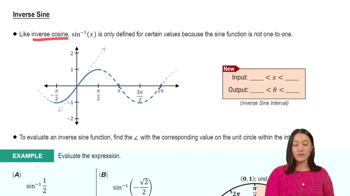
The inverse sine function, arcsin, returns the angle whose sine is a given number. Its domain is limited to [-1, 1], and its range is [-π/2, π/2]. Understanding arcsin is essential to solve equations involving it by isolating the variable inside the function.
Recommended video:
4:03
Inverse Sine

Solving Trigonometric Equations

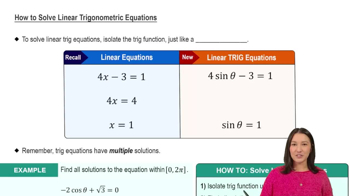
Solving trigonometric equations involves isolating the trigonometric function and then applying inverse functions to find the angle. It is important to consider the domain and range restrictions of the inverse functions to find all valid solutions.
Recommended video:
4:34
How to Solve Linear Trigonometric Equations

Exact Values of π in Trigonometry

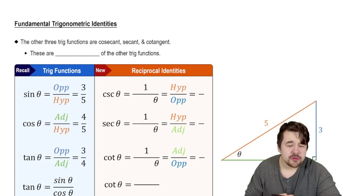
Trigonometric equations often involve multiples of π, representing angles in radians. Recognizing and manipulating these exact values helps in expressing solutions precisely, rather than as decimal approximations.
Recommended video:
5:32
Fundamental Trigonometric Identities