Graph each function over a two-period interval. y = tan(2x - π)
Verified step by step guidance
1
Identify the function given: \(y = \tan(2x - \pi)\). This is a tangent function with a horizontal transformation inside the argument.
Recall the general form of the tangent function: \(y = \tan(bx - c)\), where the period is given by \(\frac{\pi}{|b|}\). For this function, \(b = 2\), so the period is \(\frac{\pi}{2}\).
Since the problem asks for a two-period interval, calculate the length of the interval as \(2 \times \frac{\pi}{2} = \pi\). This means you will graph the function over an interval of length \(\pi\).
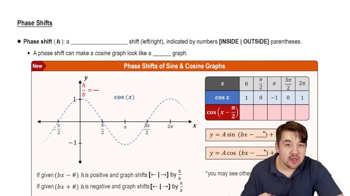
Determine the horizontal shift caused by the phase shift \(-\pi\) inside the argument. Set the inside of the tangent function equal to zero to find the shift: \(2x - \pi = 0 \Rightarrow x = \frac{\pi}{2}\). This means the graph is shifted to the right by \(\frac{\pi}{2}\).
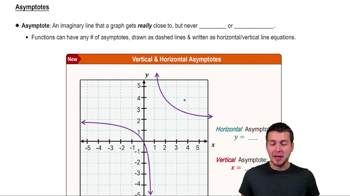
Plot the key points and asymptotes for the tangent function over the interval \(\left[ \frac{\pi}{2}, \frac{\pi}{2} + \pi \right]\). Remember that tangent has vertical asymptotes where its argument equals \(\frac{\pi}{2} + k\pi\), for integers \(k\). Use these to sketch the graph accurately.
Verified video answer for a similar problem:
This video solution was recommended by our tutors as helpful for the problem above
Play a video:
0 Comments
Key Concepts
Here are the essential concepts you must grasp in order to answer the question correctly.
Period of the Tangent Function
The basic period of the tangent function, tan(x), is π. When the function is transformed to tan(bx), the period changes to π divided by the absolute value of b. Understanding this helps determine the length of one full cycle on the x-axis, which is essential for graphing over a specified interval.
A phase shift occurs when the input variable x is replaced by (x - c), shifting the graph horizontally. For y = tan(2x - π), factoring inside the argument reveals the horizontal shift, which affects where the function's key features like asymptotes and zeros occur on the graph.
The tangent function has vertical asymptotes where the cosine function equals zero, causing tan(x) to be undefined. For transformed functions like tan(2x - π), asymptotes occur at specific x-values found by solving the inside of the tangent equal to odd multiples of π/2. Identifying these asymptotes is crucial for accurate graphing.

 Verified step by step guidance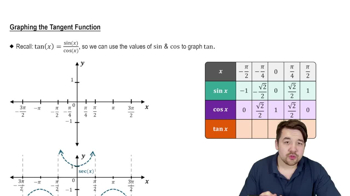
 5:43
5:43