Find each exact function value. See Example 2. tan 3π/4
Verified step by step guidance
1
Recall that the tangent function is periodic with period \(\pi\), so \(\tan\left(\theta + \pi\right) = \tan\theta\). This can help simplify angles if needed.
Identify the angle \(\frac{3\pi}{4}\) in terms of a reference angle in the unit circle. Note that \(\frac{3\pi}{4} = \pi - \frac{\pi}{4}\), which places the angle in the second quadrant.
Use the tangent subtraction formula or the identity for tangent in the second quadrant: \(\tan\left(\pi - \alpha\right) = -\tan\alpha\). Here, \(\alpha = \frac{\pi}{4}\).
Recall the exact value of \(\tan\frac{\pi}{4}\), which is 1, since tangent of 45 degrees (or \(\frac{\pi}{4}\) radians) equals 1.
Combine these facts to express \(\tan\frac{3\pi}{4}\) as \(-\tan\frac{\pi}{4}\), which simplifies to \(-1\).
Verified video answer for a similar problem:
This video solution was recommended by our tutors as helpful for the problem above
Play a video:
0 Comments
Key Concepts
Here are the essential concepts you must grasp in order to answer the question correctly.
Understanding the Unit Circle
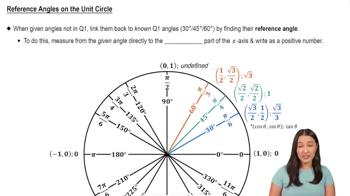
The unit circle is a circle with radius 1 centered at the origin of the coordinate plane. It helps define trigonometric functions for all angles by relating angles to coordinates (x, y) on the circle, where x = cos(θ) and y = sin(θ). Knowing the unit circle allows you to find exact values of trig functions for special angles like 3π/4.
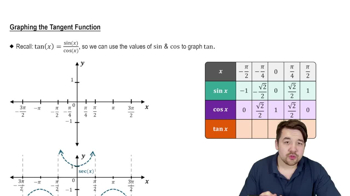
The tangent of an angle θ is defined as the ratio of the sine to the cosine of that angle: tan(θ) = sin(θ)/cos(θ). This ratio can be positive or negative depending on the quadrant in which the angle lies. Understanding this ratio is essential to compute tan(3π/4) exactly.
Reference angles are acute angles used to find trig values of angles in different quadrants by relating them to known values in the first quadrant. The angle 3π/4 lies in the second quadrant, where sine is positive and cosine is negative, affecting the sign of the tangent function. Recognizing the quadrant helps determine the correct sign of the function value.

 Verified step by step guidance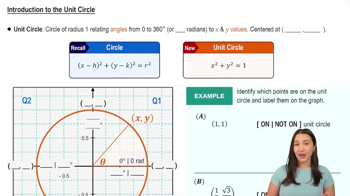
 06:11
06:11