Ch. 1 - Angles and the Trigonometric Functions
Blitzer - Trigonometry 3rd Edition
Blitzer3rd EditionTrigonometryISBN: 9780137316601Not the one you use?Change textbook
Chapter 1, Problem 1

Convert 135° to an exact radian measure.

Verified step by step guidance
1
Recall the formula to convert degrees to radians: \(\text{radians} = \text{degrees} \times \frac{\pi}{180}\).
Substitute the given degree measure into the formula: \(135^\circ \times \frac{\pi}{180}\).
Simplify the fraction \(\frac{135}{180}\) by finding the greatest common divisor (GCD) of 135 and 180.
Divide numerator and denominator by their GCD to reduce the fraction to its simplest form.
Express the final radian measure as the simplified fraction multiplied by \(\pi\), which gives the exact radian measure.

Verified video answer for a similar problem:

This video solution was recommended by our tutors as helpful for the problem above.
Video duration:
2m
Was this helpful?

Key Concepts

Here are the essential concepts you must grasp in order to answer the question correctly.

Degree to Radian Conversion

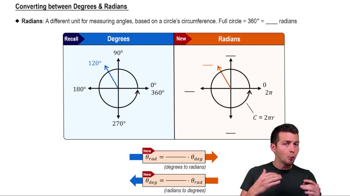
Degrees and radians are two units for measuring angles. To convert degrees to radians, multiply the degree measure by π/180. This conversion is essential because radians are the standard unit in many mathematical contexts, especially calculus and trigonometry.
Recommended video:
5:04
Converting between Degrees & Radians

Exact Radian Measures

An exact radian measure expresses the angle in terms of π rather than a decimal approximation. For example, 135° converts to (135 × π)/180 = (3π)/4 radians. Using exact values preserves precision in calculations and symbolic manipulation.
Recommended video:
5:04
Converting between Degrees & Radians

Simplifying Fractions

After converting degrees to radians, simplifying the resulting fraction is important for clarity and ease of use. This involves reducing the numerator and denominator by their greatest common divisor, resulting in a simpler fraction like 3π/4 instead of 135π/180.
Recommended video:
4:02
Solving Linear Equations with Fractions