Ch. 1 - Trigonometric Functions
Lial - Trigonometry 12th Edition
Lial12th EditionTrigonometryISBN: 9780136552161Not the one you use?Change textbook
Chapter 2, Problem 2

Fill in the blank(s) to correctly complete each sentence.
An isosceles right triangle has one ________________ angle and ______________ equal sides.

Verified step by step guidance
1
Recall that an isosceles right triangle is a triangle with a right angle (90 degrees) and two equal sides.
Since it has a right angle, one angle is exactly \(90^\circ\).
The other two angles must be equal because the triangle is isosceles, and the sum of all angles in a triangle is \(180^\circ\).
Calculate the measure of each of the other two angles using the equation: \(90^\circ + 2x = 180^\circ\), where \(x\) is the measure of each equal angle.
Identify that the triangle has one right angle and two equal sides opposite the equal angles.

Verified video answer for a similar problem:

This video solution was recommended by our tutors as helpful for the problem above.
Video duration:
1m
Was this helpful?

Key Concepts

Here are the essential concepts you must grasp in order to answer the question correctly.

Isosceles Triangle Properties

An isosceles triangle has at least two sides of equal length. These equal sides create two equal angles opposite them, which is fundamental in identifying and solving problems involving isosceles triangles.
Recommended video:
4:42
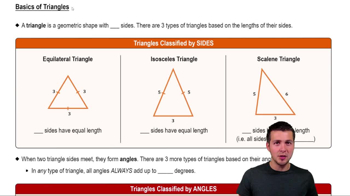
Review of Triangles

Right Triangle Characteristics

A right triangle contains one angle exactly equal to 90 degrees. This right angle defines the triangle's shape and influences the relationships between its sides and angles, especially in trigonometric contexts.
Recommended video:
5:35
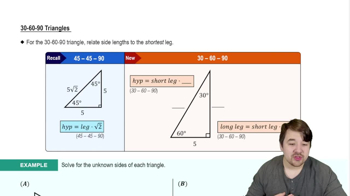
30-60-90 Triangles

Angle Sum Property of Triangles

The sum of the interior angles in any triangle is always 180 degrees. This property allows calculation of unknown angles when some angles are known, which is essential for completing sentences about specific triangle types.
Recommended video:
4:47
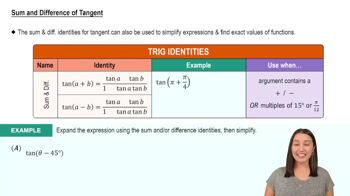
Sum and Difference of Tangent