Ch. 1 - Trigonometric Functions
Lial - Trigonometry 12th Edition
Lial12th EditionTrigonometryISBN: 9780136552161Not the one you use?Change textbook
Chapter 2, Problem 98

Use trigonometric function values of quadrantal angles to evaluate each expression. [cos(―180°)]² + [sin(― 180°)]²

Verified step by step guidance
1
Recall the Pythagorean identity in trigonometry: \(\cos^2 \theta + \sin^2 \theta = 1\) for any angle \(\theta\).
Identify the angle given in the problem: \(-180^\circ\). Note that \(-180^\circ\) is a quadrantal angle, which means it lies on the x-axis or y-axis of the unit circle.
Evaluate \(\cos(-180^\circ)\) and \(\sin(-180^\circ)\) using the unit circle values for quadrantal angles. Remember that \(\cos(-\theta) = \cos \theta\) and \(\sin(-\theta) = -\sin \theta\).
Square the values obtained for \(\cos(-180^\circ)\) and \(\sin(-180^\circ)\) separately, resulting in \([\cos(-180^\circ)]^2\) and \([\sin(-180^\circ)]^2\).
Add the squared values together as per the expression: \([\cos(-180^\circ)]^2 + [\sin(-180^\circ)]^2\). Use the Pythagorean identity to confirm the result.

Verified video answer for a similar problem:

This video solution was recommended by our tutors as helpful for the problem above.
Video duration:
3m
Was this helpful?

Key Concepts

Here are the essential concepts you must grasp in order to answer the question correctly.

Quadrantal Angles

Quadrantal angles are angles that lie on the x- or y-axis in the coordinate plane, typically 0°, 90°, 180°, 270°, and 360°. Their sine and cosine values are either 0, 1, or -1, which simplifies calculations. Understanding these values helps evaluate trigonometric expressions involving such angles.
Recommended video:
6:36
Quadratic Formula

Trigonometric Function Values at Specific Angles

The sine and cosine of specific angles, especially quadrantal angles, have well-known exact values. For example, cos(180°) = -1 and sin(180°) = 0. Knowing these values allows direct substitution into expressions without approximation.
Recommended video:
6:04
Introduction to Trigonometric Functions

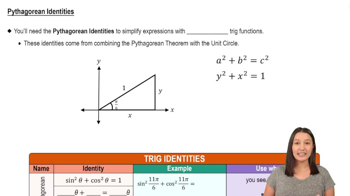
Pythagorean Identity

The Pythagorean identity states that for any angle θ, (cos θ)² + (sin θ)² = 1. This fundamental identity confirms that the sum of the squares of sine and cosine of the same angle always equals one, which is key to evaluating the given expression.
Recommended video:
6:25
Pythagorean Identities