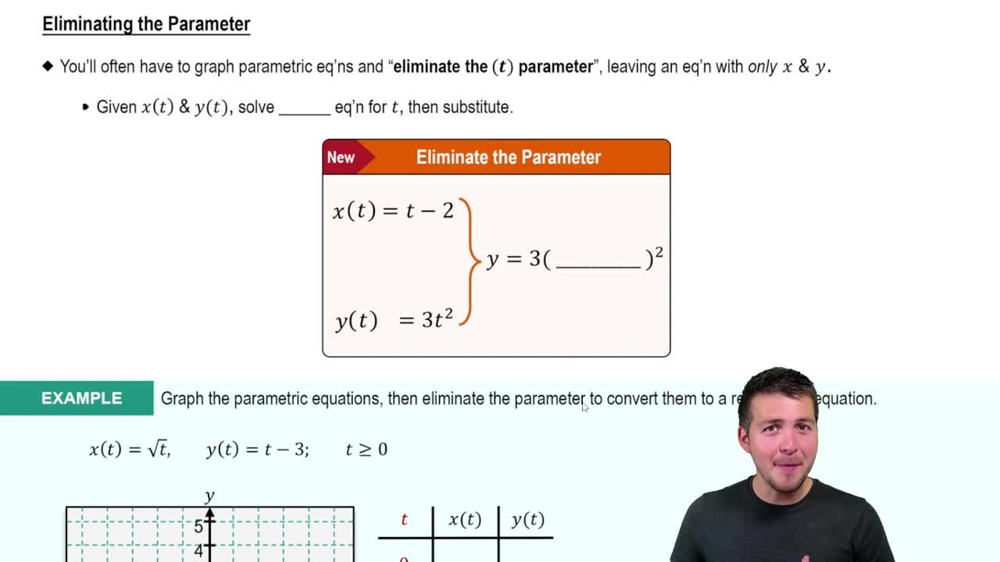
In Exercises 21–40, eliminate the parameter t. Then use the rectangular equation to sketch the plane curve represented by the given parametric equations. Use arrows to show the orientation of the curve corresponding to increasing values of t. (If an interval for t is not specified, assume that −∞ < t < ∞.
x = 2 sin t, y = 2 cos t; 0 ≤ t < 2π
Verified step by step guidance
1
Identify the given parametric equations: \(x = 2 \sin t\) and \(y = 2 \cos t\), with the parameter \(t\) in the interval \(0 \leq t < 2\pi\).
Recall the Pythagorean identity: \(\sin^2 t + \cos^2 t = 1\). This identity will help us eliminate the parameter \(t\) by expressing \(\sin t\) and \(\cos t\) in terms of \(x\) and \(y\).
Express \(\sin t\) and \(\cos t\) from the parametric equations: \(\sin t = \frac{x}{2}\) and \(\cos t = \frac{y}{2}\).
Substitute these expressions into the Pythagorean identity to get the rectangular equation: \(\left(\frac{x}{2}\right)^2 + \left(\frac{y}{2}\right)^2 = 1\).
Simplify the equation to the standard form of a circle: \(\frac{x^2}{4} + \frac{y^2}{4} = 1\). This represents a circle centered at the origin with radius 2. To sketch the curve, draw this circle and use the parameter interval to determine the orientation, noting that as \(t\) increases from \$0$ to \(2\pi\), the point moves clockwise because \(x = 2 \sin t\) and \(y = 2 \cos t\).
Verified video answer for a similar problem:
This video solution was recommended by our tutors as helpful for the problem above
Video duration:
7m
Play a video:
0 Comments
Key Concepts
Here are the essential concepts you must grasp in order to answer the question correctly.
Parametric Equations
Parametric equations express the coordinates of points on a curve as functions of a parameter, often denoted as t. Instead of y as a function of x, both x and y depend on t, allowing the description of more complex curves and motions. Understanding how to manipulate these equations is key to analyzing the curve's shape and behavior.
Eliminating the parameter involves rewriting the parametric equations to form a single equation in x and y, removing t. This is done by expressing t from one equation and substituting into the other or using trigonometric identities. This step converts the parametric form into a rectangular (Cartesian) equation, simplifying graphing and analysis.
Orientation refers to the direction in which the curve is traced as the parameter t increases. When sketching, arrows indicate this direction, helping to understand the curve's dynamic behavior. Recognizing the interval of t and how x and y change with t is essential for accurate graphing and interpretation.

 7:36 minutes
 Verified step by step guidance
 08:02
08:02