Ch. 2 - Acute Angles and Right Triangles
Lial - Trigonometry 12th Edition
Lial12th EditionTrigonometryISBN: 9780136552161Not the one you use?Change textbook
Chapter 3, Problem 2.3.56

Use a calculator to determine whether each statement is true or false. A true statement may lead to results that differ in the last decimal place due to rounding error. 2 cos 38°22' = cos 76°44'

Verified step by step guidance
1
First, convert the given angles from degrees and minutes to decimal degrees. For example, 38°22' can be converted by calculating \(38 + \frac{22}{60}\) degrees.
Calculate the left side of the equation by evaluating \(2 \times \cos(38.3667^\circ)\) using a calculator, where 38.3667° is the decimal equivalent of 38°22'.
Calculate the right side of the equation by evaluating \(\cos(76.7333^\circ)\), where 76.7333° is the decimal equivalent of 76°44'.
Compare the two results obtained from the left and right sides. If they are equal or differ only in the last decimal place due to rounding, the statement is true; otherwise, it is false.
Optionally, recall the double-angle identity for cosine: \(2 \cos \theta = \cos(2\theta)\) is not generally true, so this can help understand why the equality might or might not hold.

Verified video answer for a similar problem:

This video solution was recommended by our tutors as helpful for the problem above.
Video duration:
2m
Was this helpful?

Key Concepts

Here are the essential concepts you must grasp in order to answer the question correctly.

Trigonometric Functions and Their Properties

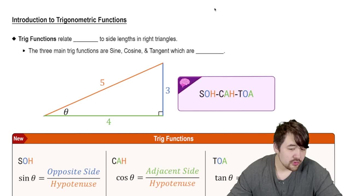
Cosine is a fundamental trigonometric function that relates an angle in a right triangle to the ratio of the adjacent side over the hypotenuse. Understanding how cosine values change with different angles is essential for evaluating and comparing expressions involving cosine.
Recommended video:
6:04
Introduction to Trigonometric Functions

Angle Measurement and Conversion

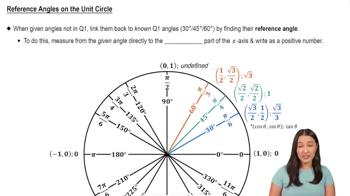
Angles can be expressed in degrees, minutes, and seconds, where 1 degree = 60 minutes and 1 minute = 60 seconds. Accurate conversion and interpretation of these units are crucial for precise calculations and comparisons in trigonometry.
Recommended video:
5:31
Reference Angles on the Unit Circle

Use of Calculators and Rounding Errors

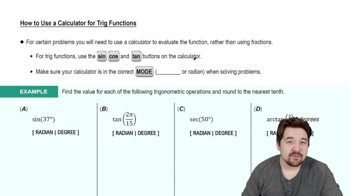
Calculators approximate trigonometric values, which can lead to small rounding errors, especially in decimal places. Recognizing that minor differences may occur due to rounding helps in correctly interpreting the truth value of trigonometric statements.
Recommended video:
4:45
How to Use a Calculator for Trig Functions
Related Practice
Textbook Question

Find a value of θ in the interval [0°, 90°) that satisfies each statement. Give answers in decimal degrees to six decimal places. See Example 2.

tan θ = 6.4358841

614
views

Textbook Question

Concept Check The two methods of expressing bearing can be interpreted using a rectangular coordinate system. Suppose that an observer for a radar station is located at the origin of a coordinate system. Find the bearing of an airplane located at each point. Express the bearing using both methods. (-3, -3)

771
views
Textbook Question

Use a calculator to approximate the value of each expression. Give answers to six decimal places. In Exercises 21–28, simplify the expression before using the calculator. See Example 1.

cos 41° 24'

608
views
Textbook Question

Use a calculator to determine whether each statement is true or false. A true statement may lead to results that differ in the last decimal place due to rounding error. cos(30° + 20°) = cos 30° + cos 20°

571
views
Textbook Question

Find a value of θ in the interval [0°, 90°) that satisfies each statement. Give answers in decimal degrees to six decimal places. See Example 2.

csc θ = 1.3861147

697
views
Textbook Question

(Modeling) Length of a Sag Curve When a highway goes downhill and then uphill, it has a sag curve. Sag curves are designed so that at night, headlights shine sufficiently far down the road to allow a safe stopping distance. See the figure. S and L are in feet. The minimum length L of a sag curve is determined by the height h of the car's headlights above the pavement, the downhill grade θ₁ < 0°, the uphill grade θ₂ > 0°, and the safe stopping distance S for a given speed limit. In addition, L is dependent on the vertical alignment of the headlights. Headlights are usually pointed upward at a slight angle α above the horizontal of the car. Using these quantities, for a 55 mph speed limit, L can be modeled by the formula (θ₂ - θ₁)S² L = ————————— , 200(h + S tan α) where S < L. (Data from Mannering, F., and W. Kilareski, Principles of Highway Engineering and Traffic Analysis, Second Edition, John Wiley and Sons.) Compute length L, to the nearest foot, if h = 1.9 ft, α = 0.9°, θ₁ = -3°, θ₂ = 4°, and S = 336 ft.

621
views