Ch. 4 - Laws of Sines and Cosines; Vectors
Blitzer - Trigonometry 3rd Edition
Blitzer3rd EditionTrigonometryISBN: 9780137316601Not the one you use?Change textbook
Chapter 4, Problem 28

In Exercises 17–32, two sides and an angle (SSA) of a triangle are given. Determine whether the given measurements produce one triangle, two triangles, or no triangle at all. Solve each triangle that results. Round to the nearest tenth and the nearest degree for sides and angles, respectively.
a = 7, b = 28, A = 12°

Verified step by step guidance
1
Identify the given elements: side \(a = 7\), side \(b = 28\), and angle \(A = 12^\circ\). Since we have two sides and a non-included angle (SSA), this is the ambiguous case in triangle solving.
Calculate the height \(h\) of the triangle using the formula \(h = b \times \sin A\). This height helps determine how many triangles can be formed.
Compare side \(a\) with the height \(h\) and side \(b\) to determine the number of possible triangles: if \(a < h\), no triangle; if \(a = h\), one right triangle; if \(h < a < b\), two triangles; if \(a \geq b\), one triangle.
If one or two triangles are possible, use the Law of Sines to find angle \(B\) by solving \(\sin B = \frac{b \sin A}{a}\). Remember to consider the possible ambiguous angle \(B'\) if two triangles exist.
After finding angle(s) \(B\), calculate angle \(C\) using \(C = 180^\circ - A - B\) (or \(B'\)), then use the Law of Sines again to find side \(c\) for each triangle. Round all answers to the nearest tenth for sides and nearest degree for angles.

Verified video answer for a similar problem:

This video solution was recommended by our tutors as helpful for the problem above.
Video duration:
8m
Was this helpful?

Key Concepts

Here are the essential concepts you must grasp in order to answer the question correctly.

Law of Sines

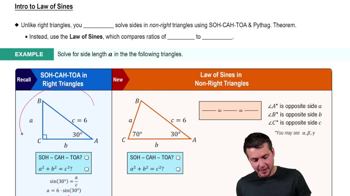
The Law of Sines relates the ratios of the lengths of sides of a triangle to the sines of their opposite angles. It is expressed as (a/sin A) = (b/sin B) = (c/sin C). This law is essential for solving triangles when two sides and a non-included angle (SSA) are given, allowing calculation of unknown angles or sides.
Recommended video:
4:27
Intro to Law of Sines

Ambiguous Case (SSA) in Triangle Solutions

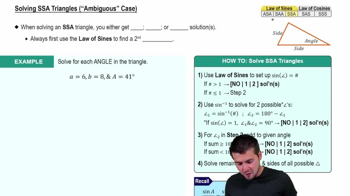
The SSA configuration can produce zero, one, or two possible triangles depending on the given measurements. This ambiguity arises because the given angle and side may correspond to different triangle shapes or no triangle at all. Understanding this case helps determine the number of valid solutions before solving.
Recommended video:
9:50
Solving SSA Triangles ("Ambiguous" Case)

Triangle Inequality and Angle-Side Relationships

The triangle inequality theorem states that the sum of any two sides must be greater than the third side. Additionally, the size of an angle is related to the length of its opposite side. These principles help verify if a triangle can exist with given measurements and assist in identifying valid solutions.
Recommended video:
5:35
30-60-90 Triangles