Ch. 2 - Acute Angles and Right Triangles
Lial - Trigonometry 12th Edition
Lial12th EditionTrigonometryISBN: 9780136552161Not the one you use?Change textbook
Chapter 3, Problem 2.3.45

Use a calculator to evaluate each expression. sin 35° cos 55° + cos 35° sin 55°

Verified step by step guidance
1
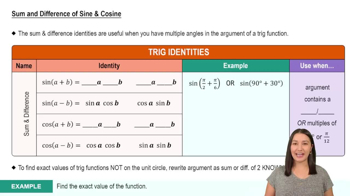
Recognize that the expression \( \sin 35^\circ \cos 55^\circ + \cos 35^\circ \sin 55^\circ \) matches the sine addition formula, which is \( \sin A \cos B + \cos A \sin B = \sin (A + B) \).
Identify the angles \( A = 35^\circ \) and \( B = 55^\circ \) in the expression.
Rewrite the expression using the sine addition formula as \( \sin (35^\circ + 55^\circ) \).
Simplify the angle inside the sine function: \( 35^\circ + 55^\circ = 90^\circ \). So the expression becomes \( \sin 90^\circ \).
Use a calculator or recall that \( \sin 90^\circ = 1 \) to evaluate the expression.

Verified video answer for a similar problem:

This video solution was recommended by our tutors as helpful for the problem above.
Video duration:
1m
Was this helpful?

Key Concepts

Here are the essential concepts you must grasp in order to answer the question correctly.

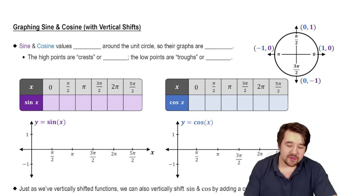
Sine and Cosine Functions

Sine and cosine are fundamental trigonometric functions that relate the angles of a right triangle to the ratios of its sides. They are periodic and defined for all real numbers, often used to model oscillatory behavior. Understanding their values at specific angles is essential for evaluating expressions.
Recommended video:
5:53
Graph of Sine and Cosine Function

Angle Sum Identity for Sine

The angle sum identity states that sin(A + B) = sin A cos B + cos A sin B. This formula allows the expression sin 35° cos 55° + cos 35° sin 55° to be simplified directly to sin(35° + 55°), making calculations easier and more intuitive.
Recommended video:
06:14
Sum and Difference of Sine & Cosine

Using a Calculator for Trigonometric Values

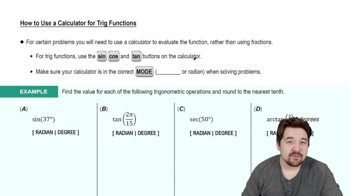
Calculators can compute sine and cosine values for given angles, typically in degrees or radians. Ensuring the calculator is set to the correct mode (degrees here) is crucial for accurate results. This skill helps in evaluating trigonometric expressions numerically.
Recommended video:
4:45
How to Use a Calculator for Trig Functions
Related Practice
Textbook Question

Use a calculator to evaluate each expression. cos 75°29' cos 14°31' - sin 75°29' sin 14°31'

639
views

Textbook Question

CONCEPT PREVIEW Match each trigonometric function value or angle in Column I with its appropriate approximation in Column II.

Column I:

cos⁻¹ 0.45

Column II:

A. 88.09084757°

B. 63.25631605°

C. 1.909152433°

D. 17.45760312°

E. 0.2867453858

F. 1.962610506

G. 14.47751219°

H. 1.015426612

I. 1.051462224

J. 0.9925461516

599
views
Textbook Question

Solve each problem. See Examples 3 and 4. The figure to the right indicates that the equation of a line passing through the point (a, 0) and making an angle θ with the x-axis is y = (tan θ) (x - a). Find an equation of the line passing through the point (5, 0) that makes an angle of 15° with the x-axis.

758
views
Textbook Question

Use a calculator to determine whether each statement is true or false. A true statement may lead to results that differ in the last decimal place due to rounding error. tan² 72°25' + 1 = sec² 72°25'

706
views
Textbook Question

Use a calculator to determine whether each statement is true or false. A true statement may lead to results that differ in the last decimal place due to rounding error. ½ sin 40° = sin [½ (40°)]

559
views
Textbook Question

Solve each problem. See Examples 1 and 2. Flying Distance The bearing from A to C is N 64° W. The bearing from A to B is S 82° W. The bearing from B to C is N 26° E. A plane flying at 350 mph takes 1.8 hr to go from A to B. Find the distance from B to C.

714
views