In Exercises 61–64, find the magnitude ||v||, to the nearest hundredth, and the direction angle θ, to the nearest tenth of a degree, for each given vector v. v = -10i + 15j
Table of contents
- 0. Review of College Algebra4h 45m
- 1. Measuring Angles40m
- 2. Trigonometric Functions on Right Triangles2h 5m
- 3. Unit Circle1h 19m
- 4. Graphing Trigonometric Functions1h 19m
- 5. Inverse Trigonometric Functions and Basic Trigonometric Equations1h 41m
- 6. Trigonometric Identities and More Equations2h 34m
- 7. Non-Right Triangles1h 38m
- 8. Vectors2h 25m
- 9. Polar Equations2h 5m
- 10. Parametric Equations1h 6m
- 11. Graphing Complex Numbers1h 7m
8. Vectors
Geometric Vectors
Problem 27c
Textbook Question
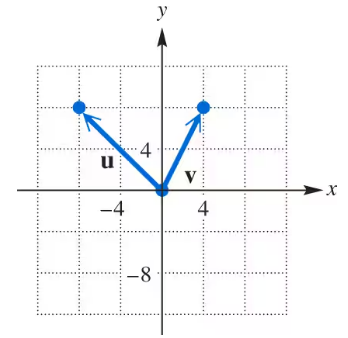
Use the figure to find each vector: - u. Use vector notation as in Example 4.

Verified step by step guidance1
Identify the vector \( \mathbf{u} \) from the figure, noting its direction and magnitude relative to the coordinate axes or reference points given.
Recall that the negative of a vector \( \mathbf{u} \), denoted \( -\mathbf{u} \), has the same magnitude as \( \mathbf{u} \) but points in the exact opposite direction.
Express the vector \( \mathbf{u} \) in component form, typically as \( \mathbf{u} = \langle u_x, u_y \rangle \), where \( u_x \) and \( u_y \) are the horizontal and vertical components respectively.
To find \( -\mathbf{u} \), multiply each component of \( \mathbf{u} \) by \( -1 \), resulting in \( -\mathbf{u} = \langle -u_x, -u_y \rangle \).
Write the final answer in vector notation, clearly indicating the components of \( -\mathbf{u} \) as derived from the previous step.
Verified video answer for a similar problem:This video solution was recommended by our tutors as helpful for the problem above
Play a video:
0 Comments
Key Concepts
Here are the essential concepts you must grasp in order to answer the question correctly.
Vector Notation
Vector notation represents vectors using components along coordinate axes, typically written as ⟨x, y⟩ in two dimensions. This notation clearly shows the direction and magnitude of the vector by specifying its horizontal and vertical components.
Recommended video:
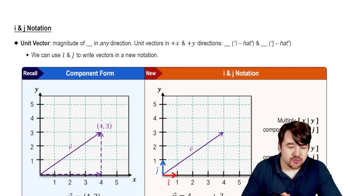
i & j Notation
Vector Addition and Subtraction
Vectors can be added or subtracted by combining their corresponding components. Understanding how to perform these operations is essential for manipulating vectors and finding resultant vectors in problems involving multiple vectors.
Recommended video:
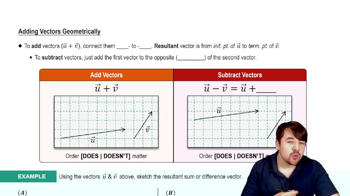
Adding Vectors Geometrically
Using Geometric Figures to Determine Vector Components
Interpreting vectors from geometric figures involves identifying their direction and length relative to coordinate axes. This skill helps translate visual information into vector notation by measuring or calculating horizontal and vertical components.
Recommended video:
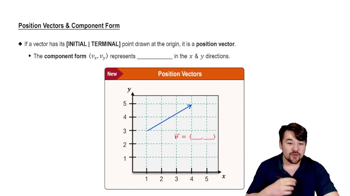
Position Vectors & Component Form
Related Videos
Related Practice
Textbook Question
652
views