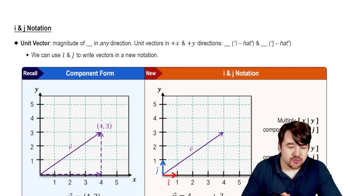
Understand that the vector given in angle bracket notation 〈x, y〉 can be expressed in terms of unit vectors \( \mathbf{i} \) and \( \mathbf{j} \), where \( \mathbf{i} \) is the unit vector in the x-direction and \( \mathbf{j} \) is the unit vector in the y-direction.
Identify the components of the vector: here, the x-component is 6 and the y-component is -3.
Write the vector as a linear combination of the unit vectors: multiply the x-component by \( \mathbf{i} \) and the y-component by \( \mathbf{j} \).
Express the vector as \( 6\mathbf{i} + (-3)\mathbf{j} \).
Simplify the expression by writing it as \( 6\mathbf{i} - 3\mathbf{j} \), which is the vector in the form \( a\mathbf{i} + b\mathbf{j} \).
Verified video answer for a similar problem:
This video solution was recommended by our tutors as helpful for the problem above
Play a video:
0 Comments
Key Concepts
Here are the essential concepts you must grasp in order to answer the question correctly.
Vector Representation in Component Form
A vector in two dimensions can be expressed as a combination of its horizontal and vertical components. These components correspond to the vector's projections along the x-axis and y-axis, respectively, and are typically written as a multiple of unit vectors i (x-direction) and j (y-direction).
Unit vectors i and j are standard basis vectors in the plane, where i represents a vector of length one in the positive x-direction, and j represents a vector of length one in the positive y-direction. Any 2D vector can be written as a linear combination of i and j.
Given a vector in coordinate form 〈x, y〉, it can be rewritten as x i + y j by multiplying the x-component by i and the y-component by j. This form clearly shows the vector's direction and magnitude along each axis.

 Verified step by step guidance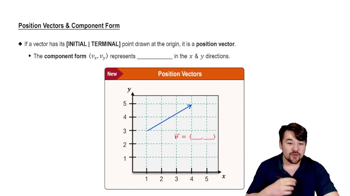
 03:55
03:55