Recognize that the expression involves the absolute value function and a negative sign outside it: \(- |4.5|\).
Recall that the absolute value of a number is its distance from zero on the number line, which is always non-negative. So, \(|4.5| = 4.5\).
Substitute the absolute value back into the expression: \(- |4.5| = - 4.5\).
Understand that the negative sign outside the absolute value changes the sign of the result, making it negative.
Therefore, the expression simplifies to \(-4.5\).
Verified video answer for a similar problem:
This video solution was recommended by our tutors as helpful for the problem above
Video duration:
1m
Play a video:
0 Comments
Key Concepts
Here are the essential concepts you must grasp in order to answer the question correctly.
Absolute Value
The absolute value of a number represents its distance from zero on the number line, regardless of direction. It is always non-negative, so |-4.5| equals 4.5. This concept is essential for evaluating expressions involving absolute value symbols.
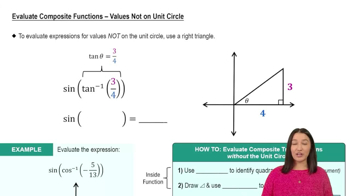
Evaluate Composite Functions - Values Not on Unit Circle
Evaluating Numerical Expressions
Evaluating an expression means simplifying it to a single numerical value. For absolute value expressions, this involves identifying the number inside the bars and applying the absolute value operation correctly.
Understanding mathematical notation, such as the vertical bars for absolute value, is crucial. Recognizing these symbols helps correctly interpret and solve problems, especially when expressions include operations like absolute value.

 1:33 minutes
 Verified step by step guidance
 7:28
7:28