Ch. 3 - Radian Measure and The Unit Circle
Lial - Trigonometry 12th Edition
Lial12th EditionTrigonometryISBN: 9780136552161Not the one you use?Change textbook
Chapter 4, Problem 2c

Work each problem.


Consider each angle in standard position having the given radian measure. In what quadrant does the terminal side lie?


-2

Verified step by step guidance
1
Recall that angles in standard position start from the positive x-axis and rotate counterclockwise for positive angles and clockwise for negative angles.
Since the given angle is -2 radians, it means the rotation is clockwise by 2 radians from the positive x-axis.
Determine the equivalent positive angle by adding \(2\pi\) radians (a full rotation) to the negative angle: \(-2 + 2\pi\).
Calculate the approximate value of the equivalent positive angle to understand its position between \(0\) and \(2\pi\) radians.
Identify the quadrant based on the equivalent positive angle: Quadrant I is between \(0\) and \(\frac{\pi}{2}\), Quadrant II between \(\frac{\pi}{2}\) and \(\pi\), Quadrant III between \(\pi\) and \(\frac{3\pi}{2}\), and Quadrant IV between \(\frac{3\pi}{2}\) and \(2\pi\).

Verified video answer for a similar problem:

This video solution was recommended by our tutors as helpful for the problem above.
Was this helpful?

Key Concepts

Here are the essential concepts you must grasp in order to answer the question correctly.

Standard Position of an Angle

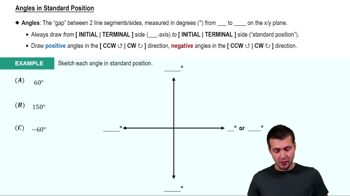
An angle in standard position has its vertex at the origin and its initial side along the positive x-axis. The terminal side is determined by rotating the initial side by the given angle measure, positive angles rotate counterclockwise, and negative angles rotate clockwise.
Recommended video:
05:50
Drawing Angles in Standard Position

Radian Measure and Angle Rotation

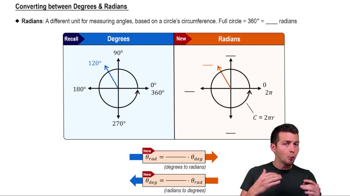
Radian measure relates the length of an arc on a unit circle to the angle it subtends. One full rotation is 2π radians. Negative radian values indicate clockwise rotation from the initial side, affecting the position of the terminal side.
Recommended video:
5:04
Converting between Degrees & Radians

Quadrants of the Coordinate Plane

The coordinate plane is divided into four quadrants numbered I to IV counterclockwise starting from the positive x-axis. The quadrant in which the terminal side lies depends on the angle's measure and direction of rotation, helping to identify the sign of trigonometric functions.
Recommended video:
6:36
Quadratic Formula