Ch. 2 - Acute Angles and Right Triangles
Lial - Trigonometry 12th Edition
Lial12th EditionTrigonometryISBN: 9780136552161Not the one you use?Change textbook
Chapter 3, Problem 64

Find all values of θ, if θ is in the interval [0°, 360°) and has the given function value. See Example 6. sec θ = -√2

Verified step by step guidance
1
Recall the definition of secant: \(\sec \theta = \frac{1}{\cos \theta}\). So, the equation \(\sec \theta = -\sqrt{2}\) can be rewritten as \(\frac{1}{\cos \theta} = -\sqrt{2}\).
Solve for \(\cos \theta\) by taking the reciprocal of both sides: \(\cos \theta = -\frac{1}{\sqrt{2}}\).
Recognize that \(\cos \theta = -\frac{1}{\sqrt{2}}\) is equivalent to \(\cos \theta = -\frac{\sqrt{2}}{2}\) after rationalizing the denominator.
Determine the reference angle where \(\cos \theta = \frac{\sqrt{2}}{2}\). This reference angle is \(45^\circ\) because \(\cos 45^\circ = \frac{\sqrt{2}}{2}\).
Since \(\cos \theta\) is negative, find all angles in the interval \([0^\circ, 360^\circ)\) where cosine is negative. Cosine is negative in the second and third quadrants, so the solutions are \(\theta = 180^\circ - 45^\circ\) and \(\theta = 180^\circ + 45^\circ\).

Verified video answer for a similar problem:

This video solution was recommended by our tutors as helpful for the problem above.
Video duration:
3m
Was this helpful?

Key Concepts

Here are the essential concepts you must grasp in order to answer the question correctly.

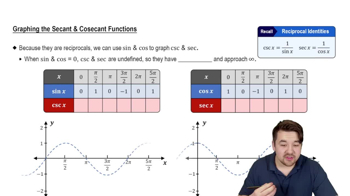
Definition of Secant Function

The secant function, sec θ, is the reciprocal of the cosine function, defined as sec θ = 1/cos θ. Understanding this relationship allows us to convert secant equations into cosine equations, which are often easier to solve.
Recommended video:
6:22
Graphs of Secant and Cosecant Functions

Solving Trigonometric Equations in a Given Interval

When solving trigonometric equations like sec θ = -√2 over [0°, 360°), it is essential to find all angles θ within the interval that satisfy the equation. This involves considering the periodicity and sign of the trigonometric functions in different quadrants.
Recommended video:
4:34
How to Solve Linear Trigonometric Equations

Sign of Trigonometric Functions in Quadrants

The sign of cosine (and thus secant) varies by quadrant: cosine is positive in the first and fourth quadrants and negative in the second and third. Since sec θ = 1/cos θ, secant shares the same sign pattern, which helps identify the correct quadrants for solutions.
Recommended video:
6:36
Quadratic Formula