Ch. 2 - Graphs of the Trigonometric Functions; Inverse Trigonometric Functions
Blitzer - Trigonometry 3rd Edition
Blitzer3rd EditionTrigonometryISBN: 9780137316601Not the one you use?Change textbook
Chapter 2, Problem 33

In Exercises 27–38, use a calculator to find the value of each expression rounded to two decimal places. _ cos⁻¹ √5/7

Verified step by step guidance
1
Identify the expression to evaluate: \(\cos^{-1} \left( \frac{\sqrt{5}}{7} \right)\), which means finding the angle whose cosine is \(\frac{\sqrt{5}}{7}\).
Calculate the value inside the inverse cosine function: first find \(\sqrt{5}\), then divide it by 7 to get the numerical value of the cosine.
Use a calculator set to degree mode (or radian mode, depending on the problem's requirement) to find the angle \(\theta = \cos^{-1} \left( \frac{\sqrt{5}}{7} \right)\).
Round the resulting angle to two decimal places as requested.
Interpret the result as the angle in degrees (or radians) whose cosine is \(\frac{\sqrt{5}}{7}\), completing the evaluation.

Verified video answer for a similar problem:

This video solution was recommended by our tutors as helpful for the problem above.
Video duration:
1m
Was this helpful?

Key Concepts

Here are the essential concepts you must grasp in order to answer the question correctly.

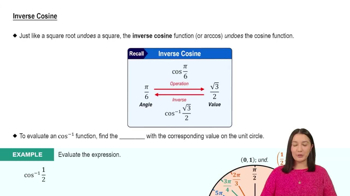
Inverse Cosine Function (cos⁻¹)

The inverse cosine function, denoted as cos⁻¹ or arccos, returns the angle whose cosine value is a given number. It is used to find an angle when the cosine of that angle is known, with the output typically in radians or degrees within the range 0 to π (0° to 180°).
Recommended video:
4:49
Inverse Cosine

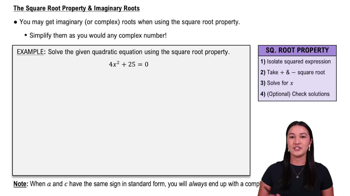
Evaluating Square Roots and Fractions

Understanding how to simplify and evaluate expressions involving square roots and fractions is essential. Here, √5/7 means the square root of 5 divided by 7, which must be calculated accurately before applying the inverse cosine function.
Recommended video:
2:20
Imaginary Roots with the Square Root Property

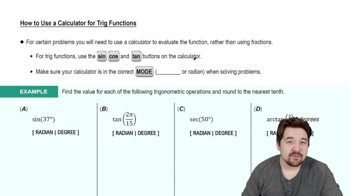
Using a Calculator for Trigonometric Functions

Calculators can compute inverse trigonometric functions and handle decimal approximations. Knowing how to input values correctly and round the result to a specified number of decimal places, such as two decimals, is crucial for obtaining the final answer.
Recommended video:
4:45
How to Use a Calculator for Trig Functions