Ch. 2 - Acute Angles and Right Triangles
Lial - Trigonometry 12th Edition
Lial12th EditionTrigonometryISBN: 9780136552161Not the one you use?Change textbook
Chapter 3, Problem 5

CONCEPT PREVIEW Match each trigonometric function value or angle in Column I with its appropriate approximation in Column II.
Column I: 1.
sin⁻¹ 0.30
Column II:
A. 88.09084757°
B. 63.25631605°
C. 1.909152433°
D. 17.45760312°
E. 0.2867453858
F. 1.962610506
G. 14.47751219°
H. 1.015426612
I. 1.051462224
J. 0.9925461516

Verified step by step guidance
1
Identify the inverse sine function given: \(\sin^{-1} 0.30\). Recall that \(\sin^{-1} x\) gives the angle whose sine is \(x\), so this corresponds to an angle in degrees or radians.
Calculate or recall the approximate value of \(\sin^{-1} 0.30\) in degrees. This will help match it with one of the angle values in Column II (values with a degree symbol).
Recognize that the other values in Column II without degree symbols are likely radian measures or decimal approximations of trigonometric function values.
Match the angle found from \(\sin^{-1} 0.30\) with the closest angle approximation in Column II, and then use the process of elimination to pair the remaining values in Column I with their corresponding approximations in Column II.
Remember that inverse trigonometric functions return angles, while trigonometric function values are decimals between -1 and 1, so use this knowledge to distinguish between angles and function values when matching.

Verified video answer for a similar problem:

This video solution was recommended by our tutors as helpful for the problem above.
Video duration:
2m
Was this helpful?

Key Concepts

Here are the essential concepts you must grasp in order to answer the question correctly.

Inverse Trigonometric Functions

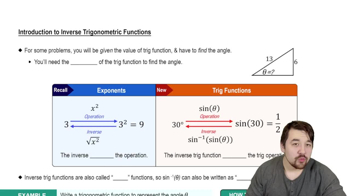
Inverse trigonometric functions, such as sin⁻¹ (arcsin), return the angle whose trigonometric ratio equals a given value. For example, sin⁻¹(0.30) gives the angle whose sine is 0.30. Understanding their domain and range is essential for correctly interpreting and matching values to angles.
Recommended video:
4:28
Introduction to Inverse Trig Functions

Angle Measurement Units (Degrees and Radians)

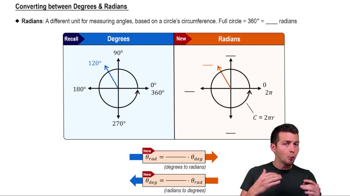
Angles can be measured in degrees or radians, two common units in trigonometry. Degrees divide a circle into 360 parts, while radians relate the angle to the radius of a circle. Recognizing and converting between these units is crucial when matching angle approximations with function values.
Recommended video:
5:04
Converting between Degrees & Radians

Approximation and Numerical Values of Trigonometric Functions

Trigonometric function values and their inverses often result in decimal approximations. Being able to interpret and compare these numerical values, whether they represent angles or function outputs, helps in correctly pairing values from different columns in matching exercises.
Recommended video:
6:04
Introduction to Trigonometric Functions
Related Practice
Textbook Question

CONCEPT PREVIEW Match each equation in Column I with the appropriate right triangle in Column II. In each case, the goal is to find the value of x.

x = 5 tan 38°

555
views

Textbook Question

CONCEPT PREVIEW Match each trigonometric function value or angle in Column I with its appropriate approximation in Column II.

Column I: 1.

tan 16°

Column II:

A. 88.09084757°

B. 63.25631605°

C. 1.909152433°

D. 17.45760312°

E. 0.2867453858

F. 1.962610506

G. 14.47751219°

H. 1.015426612

I. 1.051462224

J. 0.9925461516

572
views
Textbook Question

CONCEPT PREVIEW Match each trigonometric function in Column I with its value in Column II. Choices may be used once, more than once, or not at all.

csc 60°

646
views
Textbook Question

Concept Check Match each angle in Column I with its reference angle in Column II. Choices may be used once, more than once, or not at all. See Example 1. I. II. 5. A. 45° 6. 212° B. 60° 7. C. 82° 8. D. 30° 9. E. 38° 10. F. 32°

627
views
Textbook Question

CONCEPT PREVIEW Match each trigonometric function value or angle in Column I with its appropriate approximation in Column II.

Column I: 1.

sec 18°

Column II:

A. 88.09084757°

B. 63.25631605°

C. 1.909152433°

D. 17.45760312°

E. 0.2867453858

F. 1.962610506

G. 14.47751219°

H. 1.015426612

I. 1.051462224

J. 0.9925461516

568
views
Textbook Question

CONCEPT PREVIEW Match each trigonometric function value or angle in Column I with its appropriate approximation in Column II.

Column I: 1.

cot 27°

Column II:

A. 88.09084757°

B. 63.25631605°

C. 1.909152433°

D. 17.45760312°

E. 0.2867453858

F. 1.962610506

G. 14.47751219°

H. 1.015426612

I. 1.051462224

J. 0.9925461516

623
views