In Exercises 49–58, convert each rectangular equation to a polar equation that expresses r in terms of θ.
y² = 6x
Verified step by step guidance
1
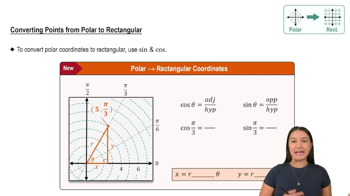
Step 1: Recall the relationship between rectangular coordinates \((x, y)\) and polar coordinates \((r, \theta)\). The conversion formulas are: \(x = r \cos \theta\) and \(y = r \sin \theta\).
Step 2: Substitute the polar coordinate expressions for \(x\) and \(y\) into the given rectangular equation \(y^2 = 6x\). This gives \((r \sin \theta)^2 = 6(r \cos \theta)\).
Step 3: Simplify the equation \((r \sin \theta)^2 = 6(r \cos \theta)\) to \(r^2 \sin^2 \theta = 6r \cos \theta\).
Step 4: Factor out \(r\) from both sides of the equation, assuming \(r \neq 0\), to get \(r \sin^2 \theta = 6 \cos \theta\).
Step 5: Solve for \(r\) in terms of \(\theta\) by dividing both sides by \(\sin^2 \theta\), resulting in \(r = \frac{6 \cos \theta}{\sin^2 \theta}\).
Verified video answer for a similar problem:
This video solution was recommended by our tutors as helpful for the problem above
Video duration:
3m
Play a video:
0 Comments
Key Concepts
Here are the essential concepts you must grasp in order to answer the question correctly.
Rectangular to Polar Coordinates
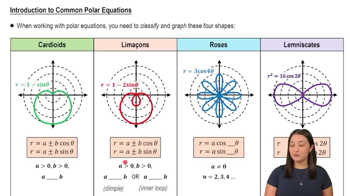
In polar coordinates, points are represented by a radius (r) and an angle (θ) rather than x and y coordinates. The conversion from rectangular to polar coordinates involves using the relationships x = r cos(θ) and y = r sin(θ). Understanding these relationships is essential for transforming equations from one coordinate system to another.
A polar equation typically expresses the radius r as a function of the angle θ. This format is crucial for analyzing curves and shapes in polar coordinates. When converting a rectangular equation, the goal is to isolate r on one side of the equation, allowing for a clear representation of the relationship between r and θ.
Graphing polar equations requires understanding how the angle θ affects the radius r. Each value of θ corresponds to a specific direction from the origin, and the value of r determines how far from the origin the point lies. Familiarity with how to interpret and plot these points is vital for visualizing the resulting polar equation.

 3:18 minutes
 Verified step by step guidance
 06:17
06:17