Join thousands of students who trust us to help them ace their exams!
Multiple Choice
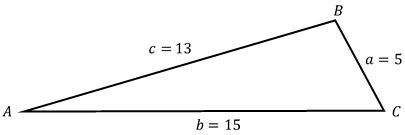
Solve the triangle: a=5, b=15, c=13.
A
A=18.9°,B=103.8°,C=57.3°
B
A=13.8°,B=108.9°,C=57.3°
C
A=13.8°,B=103.8°,C=62.4°
D
A=18.9°,B=98.7°,C=62.4°
0 Comments
Verified step by step guidance
1
Identify the given sides of the triangle: a = 5, b = 15, c = 13.
Use the Law of Cosines to find one of the angles. For example, to find angle A, use the formula: \( \cos A = \frac{b^2 + c^2 - a^2}{2bc} \). Substitute the values: \( \cos A = \frac{15^2 + 13^2 - 5^2}{2 \times 15 \times 13} \).
Calculate \( \cos A \) using the substituted values to find the cosine of angle A.
Use the inverse cosine function to find angle A: \( A = \cos^{-1}(\cos A) \).
Repeat the process using the Law of Cosines to find angles B and C, using the respective formulas: \( \cos B = \frac{a^2 + c^2 - b^2}{2ac} \) and \( \cos C = \frac{a^2 + b^2 - c^2}{2ab} \).


 Verified step by step guidance

