
Textbook Question
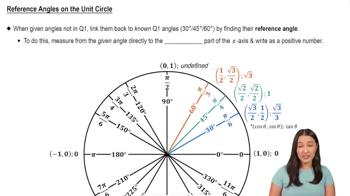
Concept Check Suppose that the point (x, y) is in the indicated quadrant. Determine whether the given ratio is positive or negative. Recall that r = √(x² + y²) .(Hint: Drawing a sketch may help.) I , r/y
566
views

 Verified step by step guidance
 5:31
5:31
 3:18
3:18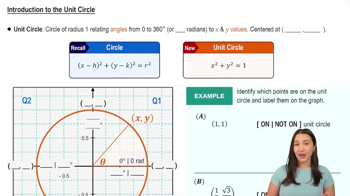 06:11
06:11Concept Check Suppose that the point (x, y) is in the indicated quadrant. Determine whether the given ratio is positive or negative. Recall that r = √(x² + y²) .(Hint: Drawing a sketch may help.) I , r/y
Concept Check Suppose that the point (x, y) is in the indicated quadrant. Determine whether the given ratio is positive or negative. Recall that r = √(x² + y²) .(Hint: Drawing a sketch may help.) I , y/r
Solve each problem. Height of a Lunar Peak The lunar mountain peak Huygens has a height of 21,000 ft. The shadow of Huygens on a photograph was 2.8 mm, while the nearby mountain Bradley had a shadow of 1.8 mm on the same photograph. Calculate the height of Bradley. (Data from Webb, T., Celestial Objects for Common Telescopes, Dover Publications.)
Perform each calculation. See Example 3. 55° 30' + 12° 44' ― 8° 15'
An equation of the terminal side of an angle θ in standard position is given with a restriction on x. Sketch the least positive such angle θ , and find the values of the six trigonometric functions of θ . See Example 3. 2x + y = 0 , x ≥ 0
Identify the quadrant (or possible quadrants) of an angle θ that satisfies the given conditions. See Example 3.
tan θ < 0 , cot θ < 0