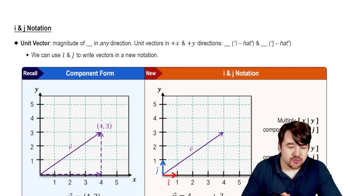
Identify the components of the vector given in angle bracket notation. Here, the vector is \( \langle 2, 0 \rangle \), where 2 is the x-component and 0 is the y-component.
Recall that the vector in the form \( a \mathbf{i} + b \mathbf{j} \) means \( a \) is the coefficient of the unit vector \( \mathbf{i} \) along the x-axis, and \( b \) is the coefficient of the unit vector \( \mathbf{j} \) along the y-axis.
Assign the x-component of the vector to \( a \) and the y-component to \( b \). So, \( a = 2 \) and \( b = 0 \).
Write the vector in the form \( a \mathbf{i} + b \mathbf{j} \) by substituting the values: \( 2 \mathbf{i} + 0 \mathbf{j} \).
Simplify the expression by removing the zero term if desired, resulting in \( 2 \mathbf{i} \).
Verified video answer for a similar problem:
This video solution was recommended by our tutors as helpful for the problem above
Play a video:
0 Comments
Key Concepts
Here are the essential concepts you must grasp in order to answer the question correctly.
Vector Representation in Component Form
Vectors in two dimensions can be expressed as a combination of unit vectors i and j, where i represents the x-axis direction and j represents the y-axis direction. Writing a vector as a i + b j means expressing it in terms of its horizontal (a) and vertical (b) components.
The unit vectors i and j are standard basis vectors in 2D space, with i = 〈1, 0〉 pointing along the x-axis and j = 〈0, 1〉 pointing along the y-axis. They serve as building blocks to represent any vector by scaling and adding these units.
A vector given in coordinate form 〈x, y〉 can be rewritten as x i + y j by associating the first component with i and the second with j. This conversion helps in vector operations and visualizing vectors in terms of directions.

 Verified step by step guidance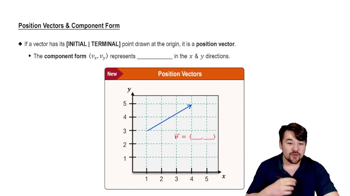
 03:55
03:55