Graph each plane curve defined by the parametric equations for t in [0, 2π] Then find a rectangular equation for the plane curve. See Example 3.
x = 2 cos t , y = 2 sin t
Verified step by step guidance
1
Identify the given parametric equations: \(x = 2 \cos t\) and \(y = 2 \sin t\), where \(t\) ranges from \(0\) to \(2\pi\).
Recall the Pythagorean identity: \(\cos^2 t + \sin^2 t = 1\). This identity will help us eliminate the parameter \(t\) to find a rectangular equation.
Express \(\cos t\) and \(\sin t\) in terms of \(x\) and \(y\): from \(x = 2 \cos t\), we get \(\cos t = \frac{x}{2}\); from \(y = 2 \sin t\), we get \(\sin t = \frac{y}{2}\).
Substitute these expressions into the Pythagorean identity: \(\left(\frac{x}{2}\right)^2 + \left(\frac{y}{2}\right)^2 = 1\).
Simplify the equation to get the rectangular form: \(\frac{x^2}{4} + \frac{y^2}{4} = 1\), which represents the equation of the curve in the \(xy\)-plane.
Verified video answer for a similar problem:
This video solution was recommended by our tutors as helpful for the problem above
Video duration:
3m
Play a video:
0 Comments
Key Concepts
Here are the essential concepts you must grasp in order to answer the question correctly.
Parametric Equations
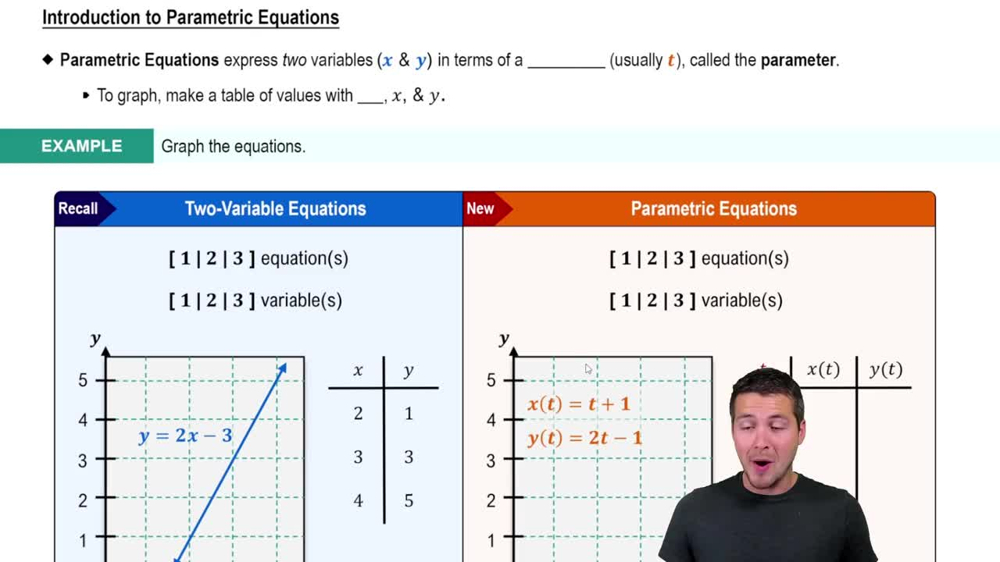
Parametric equations express the coordinates of points on a curve as functions of a parameter, often denoted as t. Instead of y as a function of x, both x and y depend on t, allowing the description of more complex curves and motions.
To graph parametric curves, plot points (x(t), y(t)) for values of t within the given interval. This approach helps visualize the path traced by the parameter, revealing shapes like circles, ellipses, or other plane curves.
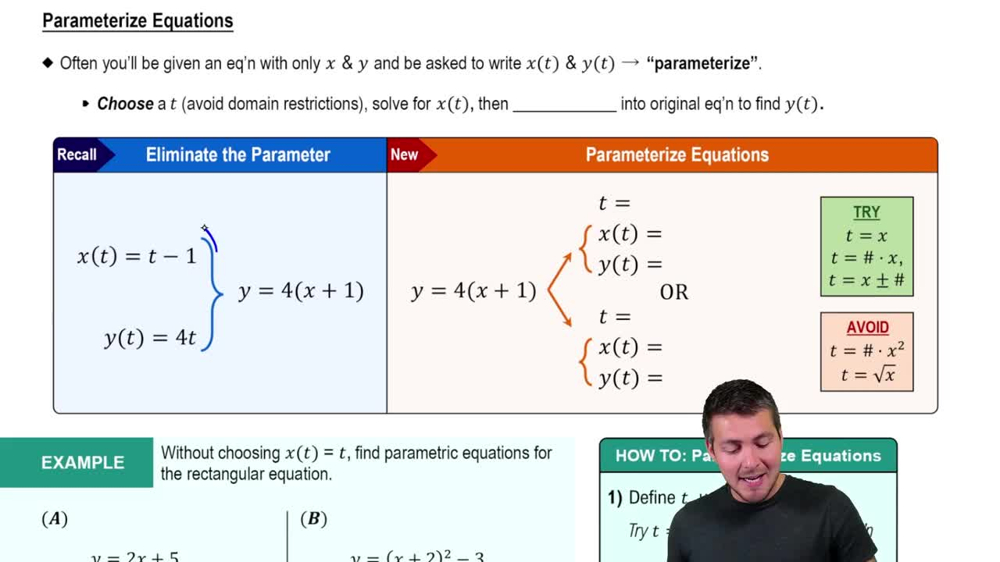
Converting parametric equations to a rectangular form involves eliminating the parameter t to find a direct relationship between x and y. For trigonometric parametrics like x = 2 cos t and y = 2 sin t, using identities such as cos²t + sin²t = 1 helps derive the rectangular equation.

 3:25 minutes
 Verified step by step guidance
 08:02
08:02