Ch. 2 - Acute Angles and Right Triangles
Lial - Trigonometry 12th Edition
Lial12th EditionTrigonometryISBN: 9780136552161Not the one you use?Change textbook
Chapter 3, Problem 2

Find exact values of the six trigonometric functions for each angle A.

Verified step by step guidance
1
Identify the given angle \( A \) and determine if it is in a right triangle context or on the unit circle. This will guide how to find the trigonometric function values.
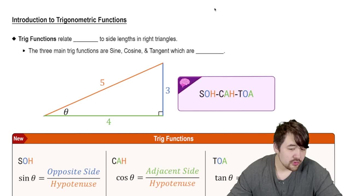
If \( A \) is an angle in a right triangle, use the definitions of the six trigonometric functions based on the sides of the triangle: - Sine: \( \sin A = \frac{\text{opposite}}{\text{hypotenuse}} \) - Cosine: \( \cos A = \frac{\text{adjacent}}{\text{hypotenuse}} \) - Tangent: \( \tan A = \frac{\text{opposite}}{\text{adjacent}} \) - Cosecant: \( \csc A = \frac{1}{\sin A} = \frac{\text{hypotenuse}}{\text{opposite}} \) - Secant: \( \sec A = \frac{1}{\cos A} = \frac{\text{hypotenuse}}{\text{adjacent}} \) - Cotangent: \( \cot A = \frac{1}{\tan A} = \frac{\text{adjacent}}{\text{opposite}} \)
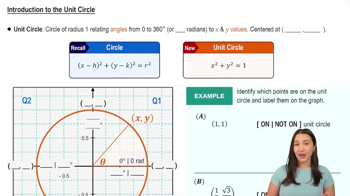
If the problem provides coordinates or the angle \( A \) is on the unit circle, use the coordinates \( (x, y) \) of the point on the circle where \( x = \cos A \) and \( y = \sin A \). Then calculate: - \( \sin A = y \) - \( \cos A = x \) - \( \tan A = \frac{y}{x} \) - \( \csc A = \frac{1}{y} \) - \( \sec A = \frac{1}{x} \) - \( \cot A = \frac{x}{y} \)
Use any given side lengths or coordinates to substitute into the formulas above. Simplify the fractions or expressions to find exact values, often involving radicals or rational numbers.
Verify the signs of the trigonometric functions based on the quadrant in which angle \( A \) lies, since sine, cosine, and tangent can be positive or negative depending on the quadrant.

Verified video answer for a similar problem:

This video solution was recommended by our tutors as helpful for the problem above.
Video duration:
5m
Was this helpful?

Key Concepts

Here are the essential concepts you must grasp in order to answer the question correctly.

Definition of the Six Trigonometric Functions

The six trigonometric functions are sine, cosine, tangent, cosecant, secant, and cotangent. They relate the angles of a right triangle to the ratios of its sides, with sine and cosine being primary, and the others defined as their reciprocals or ratios. Understanding these definitions is essential to find exact values.
Recommended video:
6:04
Introduction to Trigonometric Functions

Unit Circle and Angle Measurement

The unit circle is a circle with radius one centered at the origin of a coordinate plane. It provides a geometric way to define trigonometric functions for all angles, not just acute ones, by relating coordinates on the circle to sine and cosine values. Knowing how to use the unit circle helps find exact values for any angle.
Recommended video:
06:11
Introduction to the Unit Circle

Reference Angles and Quadrant Sign Rules

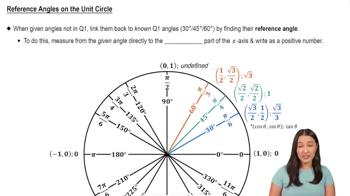
Reference angles are acute angles used to determine trigonometric values for angles in different quadrants. Each quadrant affects the sign (positive or negative) of the trigonometric functions. Applying these rules allows accurate calculation of exact values for angles beyond the first quadrant.
Recommended video:
5:31
Reference Angles on the Unit Circle