In Exercises 1–8, parametric equations and a value for the parameter t are given. Find the coordinates of the point on the plane curve described by the parametric equations corresponding to the given value of t.x = t² + 3, y = 6 − t³; t = 2
Verified step by step guidance
1
Identify the given parametric equations: \( x = t^2 + 3 \) and \( y = 6 - t^3 \).
Substitute the given value of \( t = 2 \) into the equation for \( x \): \( x = (2)^2 + 3 \).
Calculate the expression for \( x \) to find the x-coordinate.
Substitute the given value of \( t = 2 \) into the equation for \( y \): \( y = 6 - (2)^3 \).
Calculate the expression for \( y \) to find the y-coordinate.
Verified video answer for a similar problem:
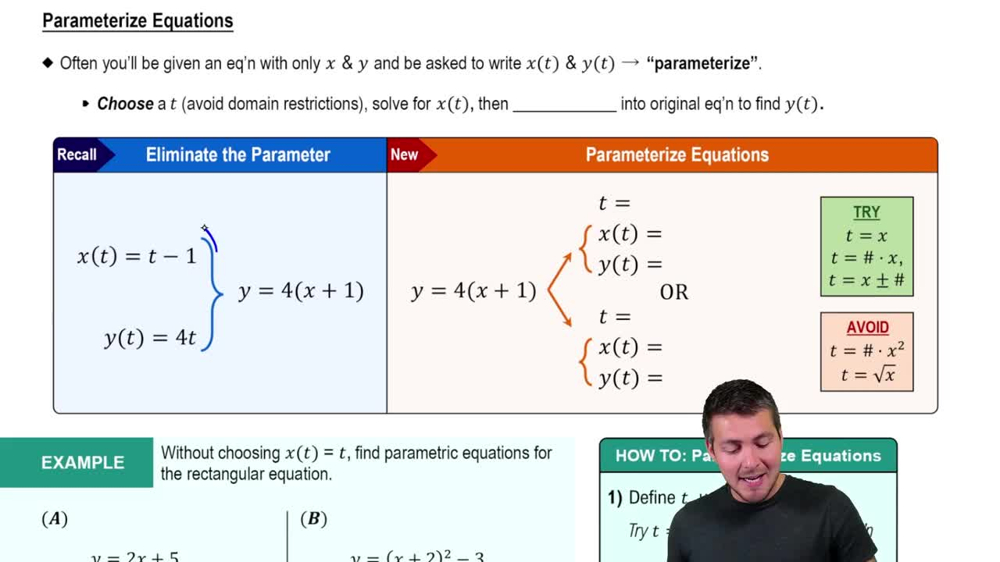
This video solution was recommended by our tutors as helpful for the problem above
Video duration:
2m
Play a video:
0 Comments
Key Concepts
Here are the essential concepts you must grasp in order to answer the question correctly.
Parametric Equations
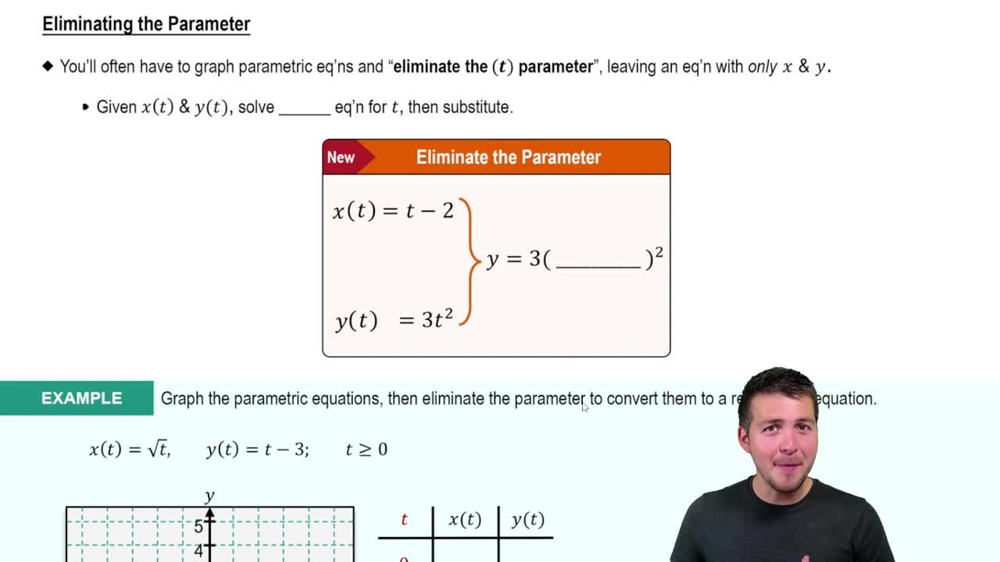
Parametric equations express the coordinates of points on a curve as functions of a variable, often denoted as 't'. In this case, x and y are defined in terms of t, allowing for the representation of curves that may not be easily described by a single equation. Understanding how to manipulate these equations is essential for finding specific points on the curve.
Substitution is a fundamental algebraic technique used to replace a variable with a specific value. In the context of parametric equations, substituting the given value of t into the equations for x and y allows us to calculate the corresponding coordinates on the curve. This step is crucial for determining the exact point represented by the parameter.
A coordinate system provides a framework for locating points in a plane using pairs of numbers, typically (x, y). In this problem, understanding how to interpret the resulting values of x and y after substitution is vital for visualizing the point on the Cartesian plane. This concept is foundational in connecting algebraic expressions to geometric representations.