Ch. 3 - Radian Measure and The Unit Circle
Lial - Trigonometry 12th Edition
Lial12th EditionTrigonometryISBN: 9780136552161Not the one you use?Change textbook
Chapter 4, Problem 45

Find a calculator approximation to four decimal places for each circular function value.
sin 1.0472

Verified step by step guidance
1
Recognize that the given angle 1.0472 is in radians, which is approximately equal to \( \frac{\pi}{3} \) radians (or 60 degrees).
Recall the definition of the sine function for an angle \( \theta \) in radians: \( \sin \theta \) gives the y-coordinate of the point on the unit circle corresponding to \( \theta \).
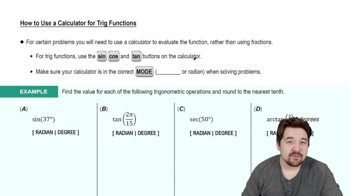
To find the sine of 1.0472 radians, you can use a scientific calculator set to radian mode.
Enter the value 1.0472 into the calculator and then press the sine function key to get the approximate value.
Round the result to four decimal places to obtain the final approximation for \( \sin 1.0472 \).

Verified video answer for a similar problem:

This video solution was recommended by our tutors as helpful for the problem above.
Video duration:
1m
Was this helpful?

Key Concepts

Here are the essential concepts you must grasp in order to answer the question correctly.

Radian Measure

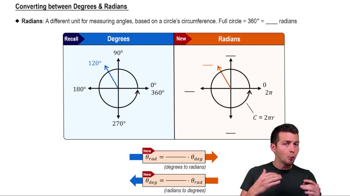
Radian measure is a way to express angles based on the radius of a circle. One radian is the angle subtended by an arc equal in length to the radius. Understanding radians is essential because trigonometric functions like sine often use radian inputs rather than degrees.
Recommended video:
5:04
Converting between Degrees & Radians

Sine Function

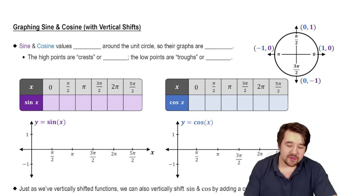
The sine function relates an angle in a right triangle to the ratio of the length of the opposite side to the hypotenuse. On the unit circle, sine corresponds to the y-coordinate of a point at a given angle. Calculating sine for a radian value involves understanding this geometric interpretation.
Recommended video:
5:53
Graph of Sine and Cosine Function

Calculator Approximation and Rounding

Calculators provide decimal approximations of trigonometric values, which are often irrational numbers. Rounding to four decimal places means limiting the result to four digits after the decimal point, ensuring a balance between precision and simplicity in practical use.
Recommended video:
4:45
How to Use a Calculator for Trig Functions