Ch. R - Algebra Review
Lial - Trigonometry 12th Edition
Lial12th EditionTrigonometryISBN: 9780136552161Not the one you use?Change textbook
Chapter 1, Problem 81

Simplify each radical. See Example 5. 3√27

Verified step by step guidance
1
Identify the expression to simplify: \(3\sqrt{27}\). Here, the radical is \(\sqrt{27}\), which means the square root of 27, and it is multiplied by 3.
Factor the number inside the square root to find perfect squares. Since \(27 = 9 \times 3\), and 9 is a perfect square, rewrite the radical as \(\sqrt{9 \times 3}\).
Use the property of square roots that \(\sqrt{a \times b} = \sqrt{a} \times \sqrt{b}\) to separate the radical: \(\sqrt{9} \times \sqrt{3}\).
Simplify the square root of the perfect square: \(\sqrt{9} = 3\), so the expression inside the radical becomes \(3 \times \sqrt{3}\).
Multiply the simplified radical by the coefficient outside: \(3 \times 3 \times \sqrt{3} = 9 \sqrt{3}\). This is the simplified form of the original expression.

Verified video answer for a similar problem:

This video solution was recommended by our tutors as helpful for the problem above.
Video duration:
2m
Was this helpful?

Key Concepts

Here are the essential concepts you must grasp in order to answer the question correctly.

Cube Roots

The cube root of a number is a value that, when multiplied by itself three times, gives the original number. For example, the cube root of 27 is 3 because 3 × 3 × 3 = 27. Understanding cube roots helps simplify expressions involving radicals with an index of 3.
Recommended video:
07:37
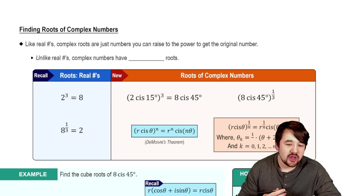
Complex Roots

Radical Simplification

Simplifying radicals involves rewriting the expression in its simplest form by factoring the radicand into perfect powers matching the root's index. For cube roots, this means extracting perfect cubes from under the radical to simplify the expression.
Recommended video:
6:20
Example 6

Properties of Exponents and Roots

Roots and exponents are inverse operations; for example, the cube root of a number is equivalent to raising that number to the power of 1/3. Using these properties allows conversion between radical and exponential forms, facilitating simplification.
Recommended video:
2:20
Imaginary Roots with the Square Root Property