Ch. 1 - Trigonometric Functions
Lial - Trigonometry 12th Edition
Lial12th EditionTrigonometryISBN: 9780136552161Not the one you use?Change textbook
Chapter 2, Problem 16

Use the appropriate reciprocal identity to find each function value. Rationalize denominators when applicable. See Example 1. cot θ , given that tan θ = 18

Verified step by step guidance
1
Recall the reciprocal identity that relates cotangent and tangent: \(\cot \theta = \frac{1}{\tan \theta}\).
Substitute the given value of \(\tan \theta = 18\) into the identity: \(\cot \theta = \frac{1}{18}\).
Since the denominator is a whole number, check if rationalization is needed. In this case, the denominator is already rational, so no further rationalization is necessary.
Express the final answer as a simplified fraction or decimal, depending on the preferred form.
Review the result to ensure it aligns with the reciprocal identity and the given value.

Verified video answer for a similar problem:

This video solution was recommended by our tutors as helpful for the problem above.
Video duration:
1m
Was this helpful?

Key Concepts

Here are the essential concepts you must grasp in order to answer the question correctly.

Reciprocal Identities

Reciprocal identities relate pairs of trigonometric functions such as tangent and cotangent, where cot θ is the reciprocal of tan θ. This means cot θ = 1 / tan θ, allowing you to find one function value if the other is known.
Recommended video:
6:25
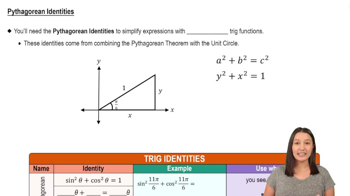
Pythagorean Identities

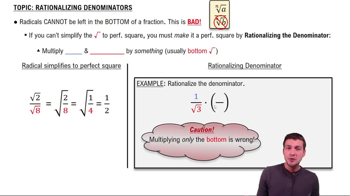
Rationalizing the Denominator

Rationalizing the denominator involves eliminating any irrational numbers (like square roots) from the denominator of a fraction. This is done by multiplying numerator and denominator by a suitable expression to simplify the expression and present it in a standard form.
Recommended video:
2:58
Rationalizing Denominators

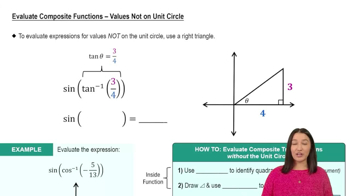
Evaluating Trigonometric Functions from Given Values

When given the value of one trigonometric function, you can use identities and algebraic manipulation to find related functions. Here, knowing tan θ allows direct calculation of cot θ using reciprocal identities, ensuring correct substitution and simplification.
Recommended video:
7:28
Evaluate Composite Functions - Values Not on Unit Circle