Use trigonometric function values of quadrantal angles to evaluate each expression. (sin 180°)² + (cos 180°)²
Verified step by step guidance
1
Identify the trigonometric function values for the quadrantal angle 180°. Recall that \( \sin 180° = 0 \) and \( \cos 180° = -1 \).
Substitute these values into the expression \((\sin 180°)^2 + (\cos 180°)^2\).
Calculate \((\sin 180°)^2\) by squaring the sine value: \((0)^2 = 0\).
Calculate \((\cos 180°)^2\) by squaring the cosine value: \((-1)^2 = 1\).
Add the results from the previous steps: \(0 + 1\).
Verified video answer for a similar problem:
This video solution was recommended by our tutors as helpful for the problem above
Video duration:
1m
Play a video:
0 Comments
Key Concepts
Here are the essential concepts you must grasp in order to answer the question correctly.
Quadrantal Angles
Quadrantal angles are angles that are multiples of 90 degrees, specifically 0°, 90°, 180°, and 270°. At these angles, the sine and cosine functions take on specific values that are easy to remember: sin(0°) = 0, sin(90°) = 1, sin(180°) = 0, sin(270°) = -1, and cos(0°) = 1, cos(90°) = 0, cos(180°) = -1, cos(270°) = 0.
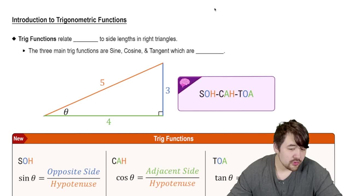
The sine and cosine functions are fundamental in trigonometry, representing the ratios of the sides of a right triangle. For quadrantal angles, these functions yield specific values: for example, sin(180°) = 0 and cos(180°) = -1. Understanding these values is crucial for evaluating expressions involving trigonometric functions.
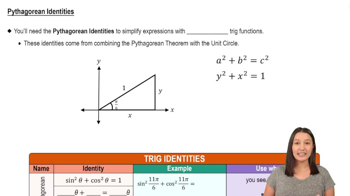
The Pythagorean identity states that for any angle θ, (sin θ)² + (cos θ)² = 1. This identity is essential in trigonometry as it relates the sine and cosine of an angle. In the context of the given expression, substituting the values of sin(180°) and cos(180°) into this identity helps confirm the evaluation of the expression.

 1:42 minutes
 Verified step by step guidance
 6:36
6:36