Use trigonometric function values of quadrantal angles to evaluate each expression. (sin 180°)² + (cos 180°)²
Verified step by step guidance
1
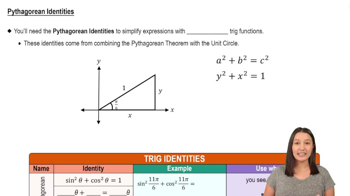
Recall the Pythagorean identity in trigonometry: \(\sin^2 \theta + \cos^2 \theta = 1\) for any angle \(\theta\).
Identify the angle given in the problem, which is \(180^\circ\), a quadrantal angle lying on the negative x-axis.
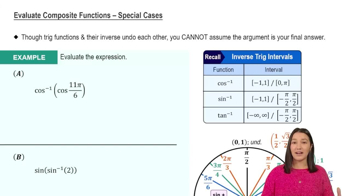
Find the exact values of \(\sin 180^\circ\) and \(\cos 180^\circ\) using the unit circle: \(\sin 180^\circ = 0\) and \(\cos 180^\circ = -1\).
Substitute these values into the expression: \((\sin 180^\circ)^2 + (\cos 180^\circ)^2 = (0)^2 + (-1)^2\).
Simplify the expression by squaring each term and adding them together to verify the identity.
Verified video answer for a similar problem:
This video solution was recommended by our tutors as helpful for the problem above
Video duration:
1m
Play a video:
0 Comments
Key Concepts
Here are the essential concepts you must grasp in order to answer the question correctly.
Quadrantal Angles
Quadrantal angles are angles that lie on the x- or y-axis in the coordinate plane, typically 0°, 90°, 180°, 270°, and 360°. Their sine and cosine values are either 0, 1, or -1, which simplifies calculations and helps evaluate trigonometric expressions easily.
The Pythagorean identity states that for any angle θ, (sin θ)² + (cos θ)² = 1. This fundamental relationship holds true for all angles, including quadrantal angles, and is essential for verifying or simplifying trigonometric expressions.
Evaluating Trigonometric Functions at Specific Angles
Evaluating sine and cosine at specific angles involves substituting the angle into the function and using known values or the unit circle. For example, sin 180° = 0 and cos 180° = -1, which can be directly applied to simplify expressions.

 1:42 minutes
 Verified step by step guidance
 6:36
6:36