Ch. 1 - Angles and the Trigonometric Functions
Blitzer - Trigonometry 3rd Edition
Blitzer3rd EditionTrigonometryISBN: 9780137316601Not the one you use?Change textbook
Chapter 1, Problem 1.3.53

In Exercises 35–60, find the reference angle for each angle. 17πœ‹ / 6

Verified step by step guidance
1
Identify the given angle: \(\frac{17\pi}{6}\) radians.
Since the angle is greater than \(2\pi\), subtract \(2\pi\) (which is \(\frac{12\pi}{6}\)) to find the equivalent angle between \(0\) and \(2\pi\): \(\frac{17\pi}{6} - 2\pi = \frac{17\pi}{6} - \frac{12\pi}{6} = \frac{5\pi}{6}\).
Determine the quadrant of the angle \(\frac{5\pi}{6}\). Since \(\frac{5\pi}{6}\) is between \(\frac{\pi}{2}\) and \(\pi\), it lies in the second quadrant.
For angles in the second quadrant, the reference angle \(\theta_r\) is calculated as \(\pi - \theta\). So, compute \(\theta_r = \pi - \frac{5\pi}{6} = \frac{\pi}{6}\).
Thus, the reference angle for \(\frac{17\pi}{6}\) is \(\frac{\pi}{6}\).

Verified video answer for a similar problem:

This video solution was recommended by our tutors as helpful for the problem above.
Video duration:
3m
Was this helpful?

Key Concepts

Here are the essential concepts you must grasp in order to answer the question correctly.

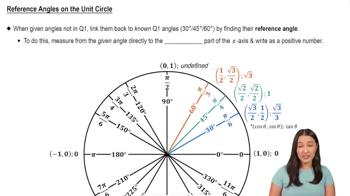
Reference Angle

A reference angle is the acute angle formed between the terminal side of a given angle and the x-axis. It is always positive and less than or equal to 90Β°, used to simplify trigonometric calculations by relating any angle to a corresponding acute angle.
Recommended video:
5:31
Reference Angles on the Unit Circle

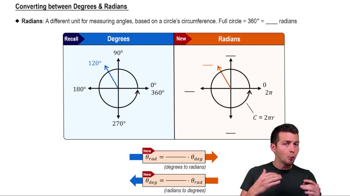
Angle Measurement in Radians

Angles can be measured in radians, where 2Ο€ radians equal 360 degrees. Understanding how to convert and interpret angles in radians is essential, especially for angles greater than 2Ο€ or negative angles, to find their equivalent positions on the unit circle.
Recommended video:
5:04
Converting between Degrees & Radians

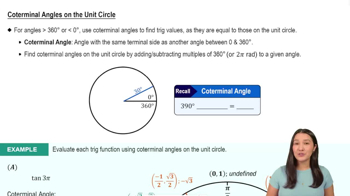
Unit Circle and Coterminal Angles

The unit circle helps visualize angles and their positions. Coterminal angles differ by full rotations of 2Ο€ radians but share the same terminal side. Finding coterminal angles within one rotation simplifies determining the reference angle.
Recommended video:
3:47
Coterminal Angles on the Unit Circle