In Exercises 21–40, eliminate the parameter t. Then use the rectangular equation to sketch the plane curve represented by the given parametric equations. Use arrows to show the orientation of the curve corresponding to increasing values of t. (If an interval for t is not specified, assume that −∞ < t < ∞. x = 2ᵗ, y = 2⁻ᵗ; t ≥ 0
Ch. 5 - Complex Numbers, Polar Coordinates and Parametric Equations

All textbooks
Blitzer 3rd Edition
Ch. 5 - Complex Numbers, Polar Coordinates and Parametric Equations
Problem 39
Blitzer 3rd Edition
Ch. 5 - Complex Numbers, Polar Coordinates and Parametric Equations
Problem 39Chapter 5, Problem 39
In Exercises 37–52, perform the indicated operations and write the result in standard form. ___ ___ 5√−16 + 3√−81
Verified step by step guidance1
Recognize that the expressions involve square roots of negative numbers, which means we are dealing with imaginary numbers. Recall that \(\sqrt{-a} = \sqrt{a} \times i\), where \(i\) is the imaginary unit with the property \(i^2 = -1\).
Rewrite each term by separating the negative sign inside the square root: \(5\sqrt{-16} = 5 \times \sqrt{16} \times i\) and \(3\sqrt{-81} = 3 \times \sqrt{81} \times i\).
Calculate the square roots of the positive numbers: \(\sqrt{16} = 4\) and \(\sqrt{81} = 9\), so the expressions become \(5 \times 4 \times i\) and \(3 \times 9 \times i\) respectively.
Multiply the coefficients: \(5 \times 4 = 20\) and \(3 \times 9 = 27\), so the terms are \$20i\( and \)27i$.
Add the two imaginary terms together: \(20i + 27i = (20 + 27)i\), which simplifies to \$47i$. This is the result in standard form, where the real part is 0 and the imaginary part is \(47\).

Verified video answer for a similar problem:
This video solution was recommended by our tutors as helpful for the problem above.
Video duration:
3mWas this helpful?
Key Concepts
Here are the essential concepts you must grasp in order to answer the question correctly.
Imaginary Numbers and Complex Numbers
Imaginary numbers arise from the square roots of negative numbers, defined using the imaginary unit i, where i² = -1. Complex numbers combine real and imaginary parts in the form a + bi, allowing operations involving roots of negative numbers to be expressed in standard form.
Recommended video:
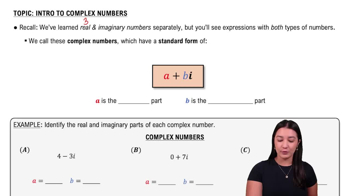
Introduction to Complex Numbers
Simplifying Square Roots of Negative Numbers
To simplify the square root of a negative number, separate it into the square root of the positive part times the square root of -1. For example, √-16 = √16 × √-1 = 4i. This process converts the expression into a form involving imaginary units, facilitating further arithmetic.
Recommended video:
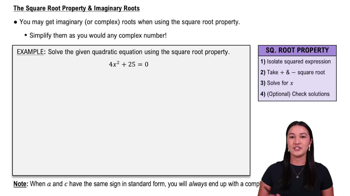
Imaginary Roots with the Square Root Property
Addition of Complex Numbers and Standard Form
Adding complex numbers involves combining their real parts and imaginary parts separately. The standard form of a complex number is a + bi, where a and b are real numbers. Writing results in this form ensures clarity and consistency in representing complex expressions.
Recommended video:
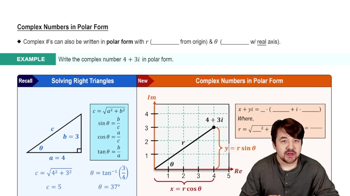
Complex Numbers In Polar Form
Related Practice
Textbook Question
772
views
Textbook Question
In Exercises 33–40, polar coordinates of a point are given. Find the rectangular coordinates of each point. (7.4, 2.5)
841
views
Textbook Question
In Exercises 35–44, test for symmetry and then graph each polar equation. r = 1 / 1−cos θ
736
views
Textbook Question
In Exercises 41–48, the rectangular coordinates of a point are given. Find polar coordinates of each point. Express θ in radians. (−2, 2)
794
views
Textbook Question
In Exercises 37–52, perform the indicated operations and write the result in standard form. __ (−2 + √−4)²
648
views
Textbook Question
In Exercises 37–44, find the product of the complex numbers. Leave answers in polar form. z₁ = cos π/4 + i sin π/4 z₂ = cos π/3 + i sin π/3
545
views