
Ch. 1 - Trigonometric Functions
Lial - Trigonometry 12th Edition
Lial12th EditionTrigonometryISBN: 9780136552161Not the one you use?Change textbook
Chapter 2, Problem 127

Solve each problem. See Example 6. Rotating Pulley A pulley rotates through 75° in 1 min. How many rotations does the pulley make in 1 hr?

Verified step by step guidance
1
Understand the problem: The pulley rotates through an angle of 75° in 1 minute, and we need to find how many full rotations it makes in 1 hour.
Recall that one full rotation corresponds to an angle of 360°. To find the number of rotations, we will convert the total angle rotated in 1 hour into the number of full 360° rotations.
Calculate the total angle rotated in 1 hour. Since 1 hour = 60 minutes, multiply the angle rotated per minute by 60: \(\text{Total angle} = 75^\circ \times 60\).
Find the number of full rotations by dividing the total angle rotated in 1 hour by 360°: \(\text{Number of rotations} = \frac{\text{Total angle}}{360^\circ}\).
Simplify the expression to get the number of rotations the pulley makes in 1 hour.

Verified video answer for a similar problem:

This video solution was recommended by our tutors as helpful for the problem above.
Video duration:
2m
Was this helpful?

Key Concepts

Here are the essential concepts you must grasp in order to answer the question correctly.

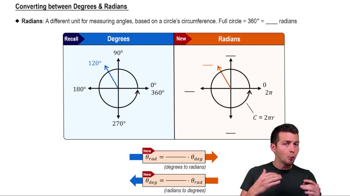
Angle Measurement in Degrees and Radians

Angles can be measured in degrees or radians, where 360° equals one full rotation. Understanding how to convert between degrees and rotations is essential for solving problems involving rotational motion.
Recommended video:
5:04
Converting between Degrees & Radians

Relationship Between Angular Displacement and Rotations

Angular displacement refers to the angle through which an object rotates. One full rotation corresponds to 360°, so the number of rotations can be found by dividing the total angular displacement by 360°.
Recommended video:
6:50
Convert Equations from Polar to Rectangular

Unit Conversion and Time Scaling

Converting time units (minutes to hours) and scaling angular displacement over time are crucial to determine total rotations over a given period. Multiplying the rotations per minute by the total minutes gives the total rotations.
Recommended video:
06:11
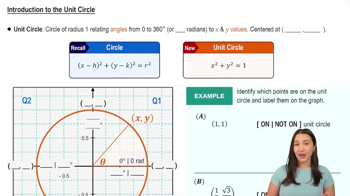
Introduction to the Unit Circle