Ch. 2 - Acute Angles and Right Triangles
Lial - Trigonometry 12th Edition
Lial12th EditionTrigonometryISBN: 9780136552161Not the one you use?Change textbook
Chapter 3, Problem 2.3.9

CONCEPT PREVIEW Match each trigonometric function value or angle in Column I with its appropriate approximation in Column II.


Column I: 1.
csc⁻¹ 4
Column II:
A. 88.09084757°
B. 63.25631605°
C. 1.909152433°
D. 17.45760312°
E. 0.2867453858
F. 1.962610506
G. 14.47751219°
H. 1.015426612
I. 1.051462224
J. 0.9925461516

Verified step by step guidance
1
Identify the trigonometric functions or inverse functions given in Column I. For example, recognize that csc⁻¹ 4 means the inverse cosecant of 4, which is the angle whose cosecant is 4.
Recall the definitions and ranges of the inverse trigonometric functions involved. For instance, the inverse cosecant function, csc⁻¹ x, returns an angle \( \theta \) such that \( \csc \theta = x \), and typically \( \theta \) lies in specific intervals depending on the function's principal values.
Calculate or estimate the angle values for each inverse trigonometric function using a calculator or known identities. For example, to find \( \theta = \csc^{-1} 4 \), use the relationship \( \csc \theta = 4 \) which implies \( \sin \theta = \frac{1}{4} \), then find \( \theta = \sin^{-1} \left( \frac{1}{4} \right) \).
Match each calculated angle or function value with the closest approximation listed in Column II by comparing the numerical values. Pay attention to whether the values are in degrees or radians and convert if necessary.
Verify the matches by checking the consistency of the values with the properties of the trigonometric functions, ensuring that the approximations correspond correctly to the given functions or angles.

Verified video answer for a similar problem:

This video solution was recommended by our tutors as helpful for the problem above.
Video duration:
4m
Was this helpful?

Key Concepts

Here are the essential concepts you must grasp in order to answer the question correctly.

Inverse Trigonometric Functions

Inverse trigonometric functions, such as csc⁻¹ (arccosecant), return the angle whose trigonometric function equals a given value. Understanding these functions is essential for converting between function values and their corresponding angles, especially when matching values to angle approximations.
Recommended video:
4:28
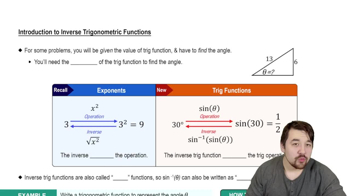
Introduction to Inverse Trig Functions

Trigonometric Function Values and Angle Approximations

Trigonometric functions produce values based on angles, and these values can be approximated numerically. Matching function values to angle approximations requires familiarity with how sine, cosine, tangent, and their reciprocals relate to specific angle measures in degrees or radians.
Recommended video:
6:04
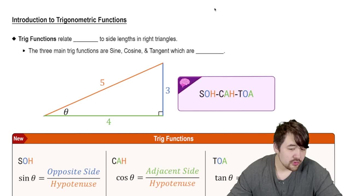
Introduction to Trigonometric Functions

Domain and Range of Trigonometric Functions

Each trigonometric function and its inverse have specific domains and ranges that restrict possible input and output values. Recognizing these constraints helps determine valid angle-value pairs and avoid extraneous or undefined solutions when matching values to angles.
Recommended video:
4:22
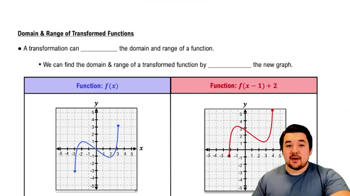
Domain and Range of Function Transformations