Ch. 2 - Graphs of the Trigonometric Functions; Inverse Trigonometric Functions
Blitzer - Trigonometry 3rd Edition
Blitzer3rd EditionTrigonometryISBN: 9780137316601Not the one you use?Change textbook
Chapter 2, Problem 5

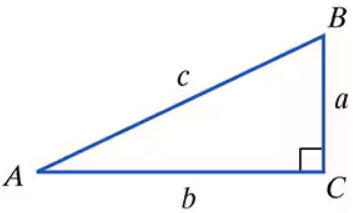
Solve the right triangle shown in the figure. Round lengths to two decimal places and express angles to the nearest tenth of a degree. B = 16.8°, b = 30.5
Right triangle ABC with angle B 16.8°, side b 30.5, right angle at C, sides a and c labeled.

Verified step by step guidance
1
Identify the given information: angle B (which corresponds to angle Q) is 16.8° and side b (which corresponds to side q) is 30.5 units.
Since triangle QRP is a right triangle with the right angle at R, use the fact that the sum of angles in a triangle is 180°. Calculate angle P as \(P = 90^\circ - B = 90^\circ - 16.8^\circ\).
Use the sine function to find side p (opposite to angle B): \(\sin(B) = \frac{p}{r}\), but since we don't know r yet, use the cosine function with side q: \(\cos(B) = \frac{q}{r}\), rearranged to find \(r = \frac{q}{\cos(B)}\).
Once you find r, use the sine function to find p: \(p = r \sin(B)\).
Finally, verify your results by checking the Pythagorean theorem: \(p^2 + q^2 = r^2\). Round all lengths to two decimal places and angles to the nearest tenth of a degree.

Verified video answer for a similar problem:

This video solution was recommended by our tutors as helpful for the problem above.
Video duration:
6m
Was this helpful?

Key Concepts

Here are the essential concepts you must grasp in order to answer the question correctly.

Right Triangle Properties

A right triangle has one angle of 90 degrees, and the side opposite this angle is the hypotenuse, the longest side. The other two sides are called legs. Understanding the relationship between angles and sides in a right triangle is essential for solving unknown lengths or angles.
Recommended video:
5:35
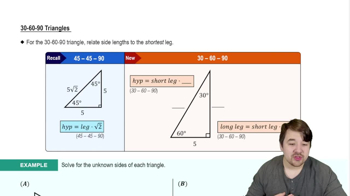
30-60-90 Triangles

Trigonometric Ratios (Sine, Cosine, Tangent)

Trigonometric ratios relate the angles of a right triangle to the ratios of its sides. Sine is opposite/hypotenuse, cosine is adjacent/hypotenuse, and tangent is opposite/adjacent. These ratios allow calculation of unknown sides or angles when one angle and one side are known.
Recommended video:
5:08
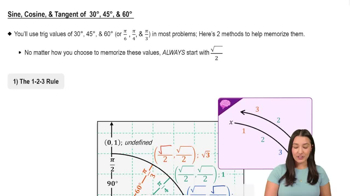
Sine, Cosine, & Tangent of 30°, 45°, & 60°

Solving Right Triangles

Solving a right triangle involves finding all unknown sides and angles using given information. This typically requires using trigonometric ratios, the Pythagorean theorem, and angle sum properties. Rounding results appropriately ensures practical and accurate answers.
Recommended video:
5:19
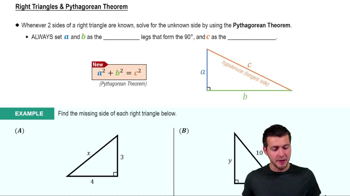
Solving Right Triangles with the Pythagorean Theorem